Your ad platform has an AI that writes headlines. Your CRM has an AI that drafts follow-up. Your website builder suggests layouts, and your email tool picks send times. Each one is good at its job. And your marketing still runs in four separate rooms with the doors closed.
That is the state of most AI marketing automation today for real estate agents, loan officers, and the brokerages and lenders behind them. The intelligence lives inside each tool, so it can only act inside that tool. Nothing above the tools decides what the whole system should do next, and nothing remembers what worked last month across all of them.
This post explains why AI inside siloed tools produces siloed results, what the missing orchestration and memory layer does, and why Evocalize built Evo, the AI marketing director for real estate and mortgage professionals, to be that layer.
Key Takeaways
- AI marketing automation built into a single tool can only optimize what that tool controls. An ad platform’s AI improves ads and a CRM’s AI improves follow-up, but neither can improve the handoff between them.
- Siloed tools produce siloed results because each one optimizes for its own metric: clicks, opens, visits, form fills. None of them is accountable for a closed transaction or a funded loan.
- The missing layer is orchestration plus memory: one director that runs ads, search, sites, email, and follow-up as a single plan and carries what it learns from one launch into the next.
- An AI marketing director works across the tools a professional already uses and coordinates best-of-breed products toward one goal.
- Evocalize built Evo to be that layer for housing professionals. Evo connects the CRM, lead sources, listings, and creative tools you already pay for, and it remembers outcomes across all of them.
What Is AI Marketing Automation, and Where Does It Live Today?
AI marketing automation is software that uses machine learning to make marketing decisions without a person making each one: which audience sees an ad, which subject line goes out, when a budget pauses, what to say to a new inquiry. It has become standard. Google and Meta optimize delivery automatically. Most CRMs now draft messages and score contacts. Website builders suggest layouts and write copy.
Each of these is a real improvement, and the tools doing it are good at what they do. The question is where the intelligence sits. In almost every case it sits inside one product, trained on that product’s data, acting on that product’s levers. The ad platform’s AI sees impressions and clicks. The CRM’s AI sees contacts and emails. The website’s AI sees page visits. None of them sees the others.
For a real estate agent or loan officer, that means the marketing stack is now a set of smart rooms with no hallway. Every room is more capable than it was two years ago. The house still has no one running it.
Why Do Siloed Tools Produce Siloed Results?
A tool can only optimize what it can measure and control. That one sentence explains most of what goes wrong.
Walk a single buyer through a typical stack:
- She sees a listing ad on Instagram. The ad platform’s AI counts a click and optimizes for more clicks like hers.
- She lands on the listing page and leaves without filling out the form. The website tool counts a visit. The ad platform never learns the click went nowhere.
- Three weeks later she signs up for a rate alert through a different lead source. The CRM’s AI scores her as a new, cold contact. It has no idea she was already interested in a specific property.
- The email tool sends her a generic welcome sequence. The follow-up call comes in with no context. She says “just browsing.”
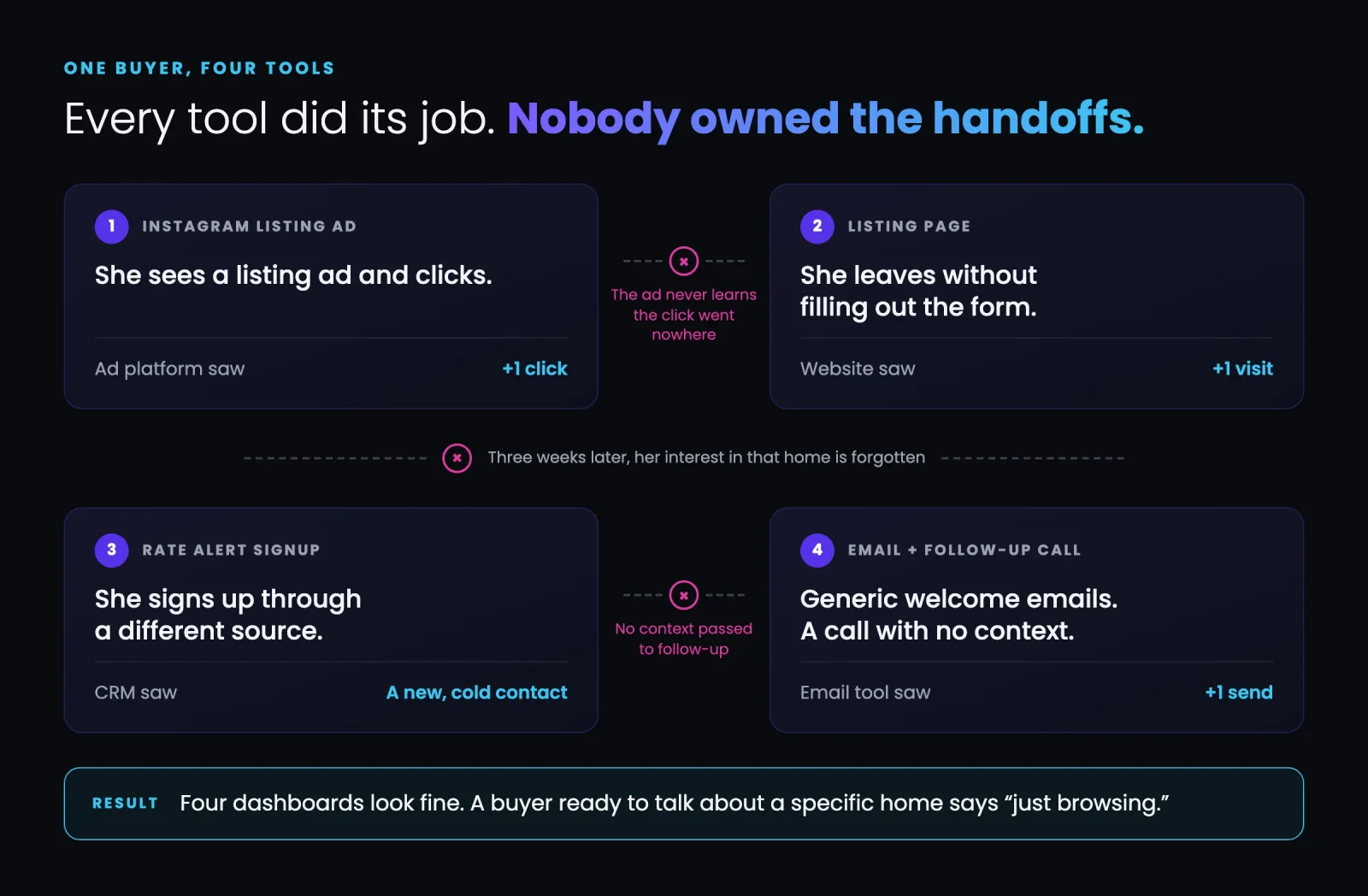
Every tool did its job. Every dashboard looks fine. And the outcome that mattered, a buyer who was ready to talk about a specific home, slipped through four handoffs that nobody owned. According to Zillow’s 2025 Consumer Housing Trends Report, 22% of buyers spend six months or more actively researching before they purchase. That is a lot of handoffs for a stack with no hallway.
The siloed results follow directly:
- Each tool optimizes for its own metric. Clicks, opens, visits, form fills. None of those is a closed transaction or a funded loan, so none of the AIs is pointed at the outcome you are paid on.
- Learning stays local. What the ad platform learns about your best audience never reaches the email tool. What follow-up learns about who actually answers the phone never reaches the ad platform.
- Budget decisions have no referee. Moving money from search to social, or from a buyer plan to a listing plan, is a cross-tool decision. No single tool’s AI can make it, so a person has to, and that person is usually busy closing.
- You become the integration layer. Exporting lists, re-uploading audiences, reading five reports to answer one question. The coordination work is exactly the work that gets skipped first when business picks up.
This is the same problem we described for loan officers in why five marketing platforms won’t give you a marketing plan. Adding AI to each platform makes every room smarter. It does nothing for the hallway.
Loan Officer Marketing Tools: Why 5 Platforms Won’t Give You a Marketing Plan
What Does AI Marketing Automation Miss Without Orchestration and Memory?
Two things, and they are the same two things a good human marketing director brings to a team.
Orchestration means one decision-maker running every channel as a single plan toward a single goal. The ad, the page it lands on, the follow-up call, the email sequence, and the audience it builds for next month are designed together. When one piece underperforms, the plan changes the piece, not the goal. That is the difference between a marketing plan and a one-off push, and it is a cross-tool job by definition.
Memory means the outcomes from one plan inform the next one, across every tool. If a neighborhood responded to video and ignored static images, the next listing in that neighborhood starts with video. If inquiries from one source answer the phone and inquiries from another never do, budget and follow-up adjust. The learning persists session after session and plan after plan, so the system gets smarter about your market and your business over time.
Here is how the two approaches compare:
| AI inside each tool | AI marketing automation with a director layer | |
|---|---|---|
| What it optimizes | That tool’s metric | The business outcome across every tool |
| What it can see | That tool’s data | Ads, site, CRM, email, and follow-up together |
| Who moves budget between channels | You | The director layer |
| What it learns | Stays inside the tool | Carries into the next plan |
| Who connects the handoffs | You, by hand | The plan |
| What compounds | Each tool’s own metric | Audience, recognition, and results |
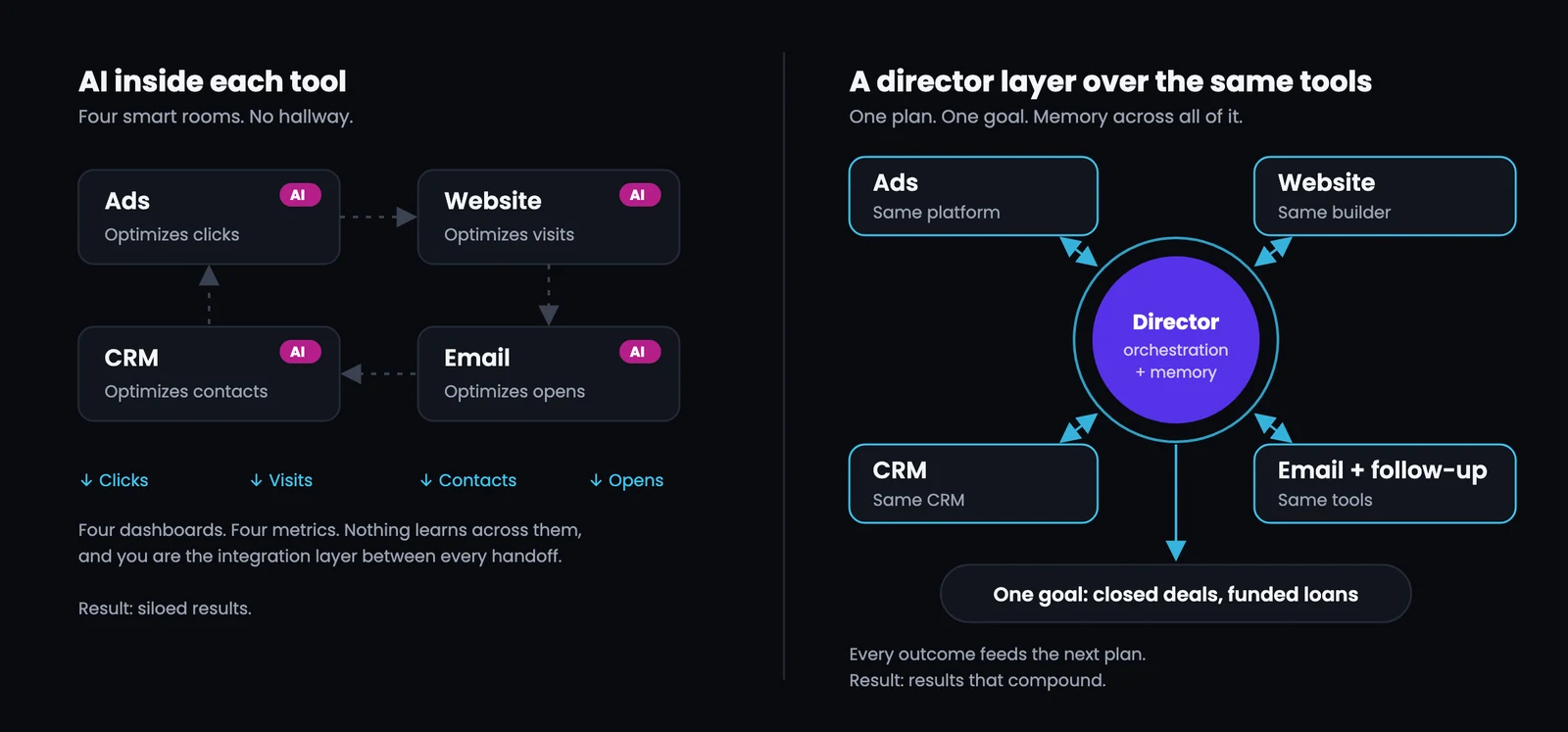
This is the standard for the category. An AI marketing director works across the tools a professional already uses and coordinates best-of-breed products toward one goal. AI marketing automation that stays inside one product has automated a task. It has not directed the marketing.
How Does an AI Marketing Director Orchestrate the Tools You Already Have?
Evocalize is the AI marketing director for real estate and mortgage professionals. The agent is named Evo, and Evo was built to be the layer this post describes: the one that sits above the tools, runs them as a system, and remembers.
Here is what that looks like in practice.
- Your tools, connected. Your CRM, lead sources, listings, and creative tools plug in as connectors. Follow Up Boss stays your CRM. Google and Meta keep delivering the ads. Realtor.com keeps sending inquiries. Evo coordinates all of them toward one goal, and every lead, wherever it originated, flows into the same plan, the same follow-up, and the same reporting.
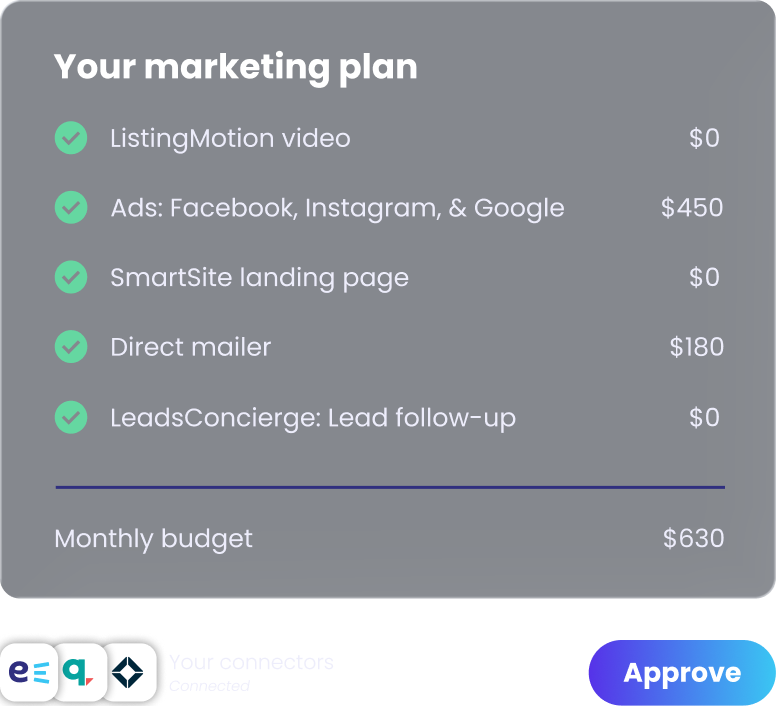
- One goal, one plan. Tell Evo what you want in plain English. “Promote every new listing.” “Keep my past clients warm this winter.” “Build a first-time buyer pipeline on the north side.” Evo builds the plan: the creative, the local audiences, a budget recommendation, and the channel mix across Google, Facebook, Instagram, TikTok, and YouTube, plus the offline pieces like postcards and email to your sphere. One approval launches all of it.
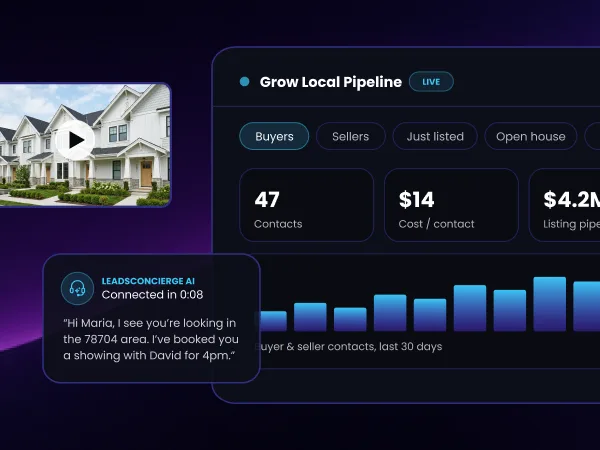
- The handoffs are designed, not improvised. ListingMotion turns listing photos into professional video. SmartSite gives every ad somewhere to land that you own. LeadsConcierge AI calls and qualifies every new inquiry within minutes, with the context of which plan it came from, which is the fix for the minutes that decide who wins the client. Leads Intelligence shows which marketing produces leads that close, so the next plan starts from that.
- Memory across all of it. Every plan, every interaction, and every outcome builds a memory of what works for your business, your market, and your goals. That memory persists month over month, so the plan that launches in March is smarter than the one that launched in January.
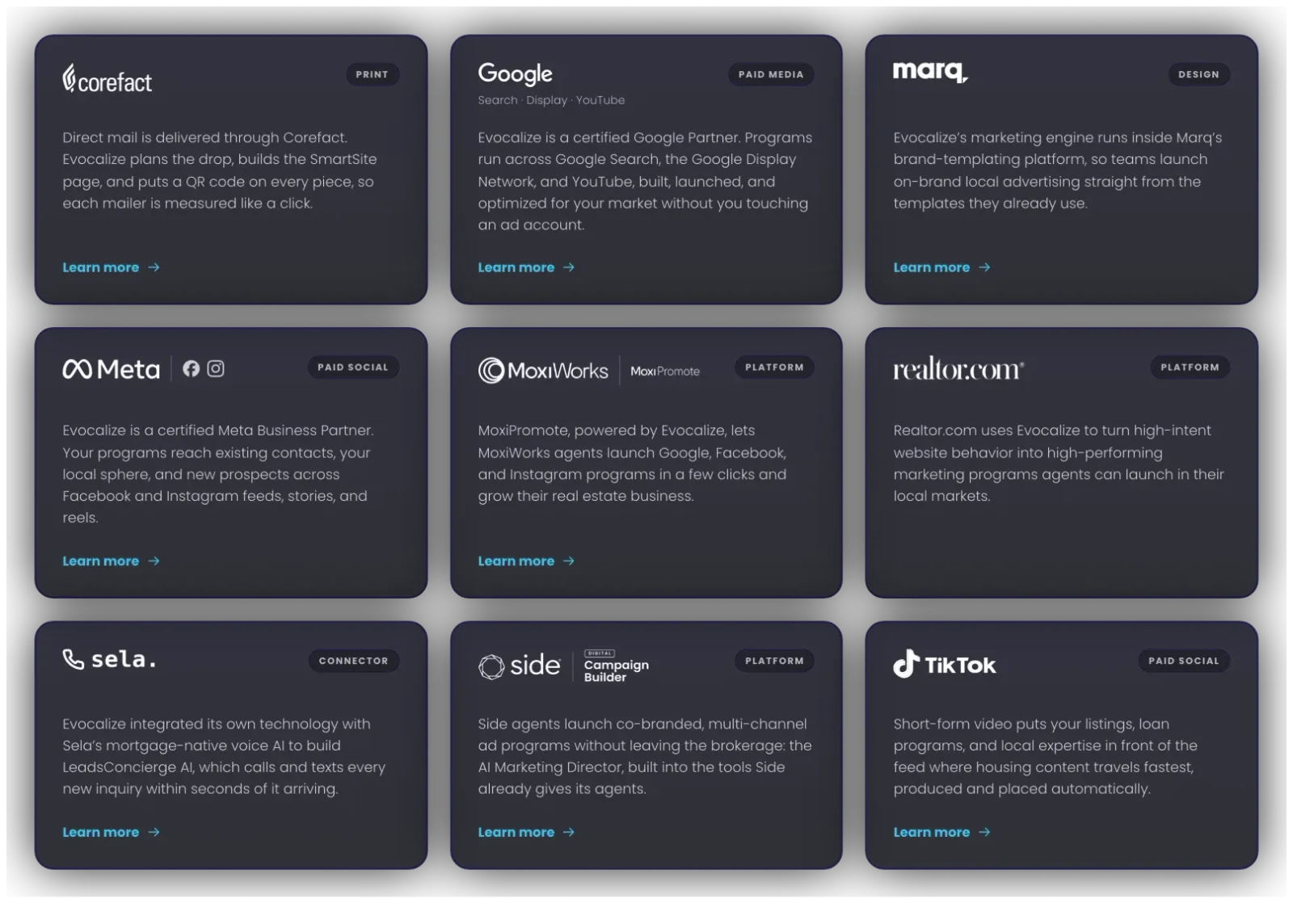
The same orchestration is what makes your referral partners easier to work with. A co-marketed listing launch carries both brands, lands on one page, and feeds one follow-up system, so the agent or loan officer you run it with sees the results too. Running marketing together is a partnership, and every co-marketed plan is a reason to be in front of that partner again next month.
What Is an AI Marketing Director? The Role Every Real Estate and Mortgage Pro Can Finally Afford
What Does Orchestrated Marketing Produce, and How Do You Start?
Marketing that runs as one coordinated system compounds. Audiences build, local recognition builds, and follow-up gets faster and better informed with every plan. Marketing that runs as separate tools has to be reassembled by hand each time, which is why so many agents and LOs feel like they are starting over every quarter.
Evocalize customers running coordinated plans show what the compounding looks like.
One loan officer started a $100-a-month plan and closed her first loan within three months, with a second deal active, and the first lead from it went on to send her multiple referrals. The budget was modest. The system around it was complete, with the ads, the landing experience, and the follow-up running together as one plan.
At the enterprise level, one of Evocalize’s lender partners has generated more than $1 billion in loan applications with a 300% return on marketing investment across its loan officers, with marketing running the same coordinated way for every producer.
The pattern in both stories is the same one that runs through why real estate leads don’t convert and how agents re-engage their database: the result came from the system, not from any single tool inside it.

300% ROI
$1B+ in loan applications generated at local scale across their loan officers.

100x ROI
$6,000 in Evocalize marketing turned into $23M in closed sales over a year.
 James Edwards
United Country Real Estate

1,335% ROI
$3,064 in marketing turned into $44,000 in commissions by acting on new inquiries within five minutes.
 Jasmina Law
eXp Realty
Getting started with orchestrated AI marketing automation takes a sentence, not a migration:
- Name the goal that is already nagging you. “Promote every listing.” “More buyer conversations this spring.” “Keep my sphere warm year-round.” Plain English is the entire brief.
- Connect what you already run. Your CRM, your lead sources, your listings, and your creative tools plug in as connectors. The first plan launches with your brand and your contacts already in place.
- Approve the first plan. You get back the creative, the local audiences, a budget recommendation, and the channel mix. One approval launches it.
- Let the memory build. Pick a budget you would keep running for a year. Momentum typically builds over 6 to 12 months, and every plan after the first starts smarter.
Timing matters here. According to a Realtor.com survey, 82% of Americans already use AI for housing market information. The professionals whose marketing is run by a director, with every tool pulling in the same direction, are the ones who show up consistently in that world. The ones whose marketing is a set of disconnected automations show up wherever the last tool happened to point. Agents weighing this shift can read more in AI marketing for real estate agents.
Frequently Asked Questions
What is AI marketing automation?
AI marketing automation is software that uses machine learning to make marketing decisions on its own: who sees an ad, what message goes out, when budget moves, and how a new inquiry gets answered. Most of it today is built into individual tools like ad platforms, CRMs, and email systems. The next step is AI marketing automation that works across those tools as one plan, which is what an AI marketing director does.
Why doesn’t adding AI to each of my marketing tools fix the silo problem?
Because each tool’s AI can only see and act on that tool’s data. Your ad platform’s AI gets better at ads and your CRM’s AI gets better at follow-up, but neither can see the handoff between them, and neither can move budget from one channel to another. The gaps between tools are where buyers and borrowers get lost, and no amount of intelligence inside a single tool can close a gap that sits outside it.
Do I have to replace my CRM or ad accounts to use an AI marketing director?
No. An AI marketing director works across the tools a professional already uses. With Evocalize, your CRM, lead sources, listings, and creative tools plug in as connectors, and Evo coordinates them inside one plan. You keep the tools you like and the relationships and data inside them. What changes is that something above them is now running them toward one goal.
How is an AI marketing director different from a marketing automation platform?
A marketing automation platform executes the workflows you design inside it, and it does that well. An AI marketing director decides the plan itself, runs it across every tool you use, including a marketing automation platform if you have one, and carries the outcomes into what it runs next. One is a capable tool you operate. The other is the director operating the tools for you.
How long before orchestrated marketing shows results?
Some plans produce inquiries in the first weeks, especially listing promotion. Meaningful pipeline momentum typically builds over 6 to 12 months, because audiences, local recognition, and the system’s memory of what works all compound with time. The professionals who see the strongest results are the ones who keep a modest budget running continuously and let each plan start smarter than the last.
Put a Director Over the Tools You Already Have
Your tools are good. The gap between them is the problem, and it is a gap only a director can close. Describe the goal in one sentence, and Evo builds the plan, connects your tools, runs the handoffs, and remembers what worked so the next one starts ahead.