Four vendors will tell you they sell a real estate marketing platform. One sells you leads. One sells you templates. One stores your contacts and sends email. One actually plans, builds, and runs your marketing. Same two words on every website, four completely different products behind them.
That is why so many of these purchases disappoint. Agents and brokerage marketers compare feature lists across categories that were never comparable, buy the one with the longest list, and discover six weeks later that they still have to do the work themselves.
This guide fixes the comparison. It covers what a real estate marketing platform is, the four types hiding behind the label, the seven jobs any of them has to cover, and the nine questions that tell you which type you are actually looking at before you sign anything.
Key takeaways
- A real estate marketing platform is software that handles the planning, production, distribution, and measurement of your marketing in one place, instead of leaving those steps spread across separate tools and your own calendar.
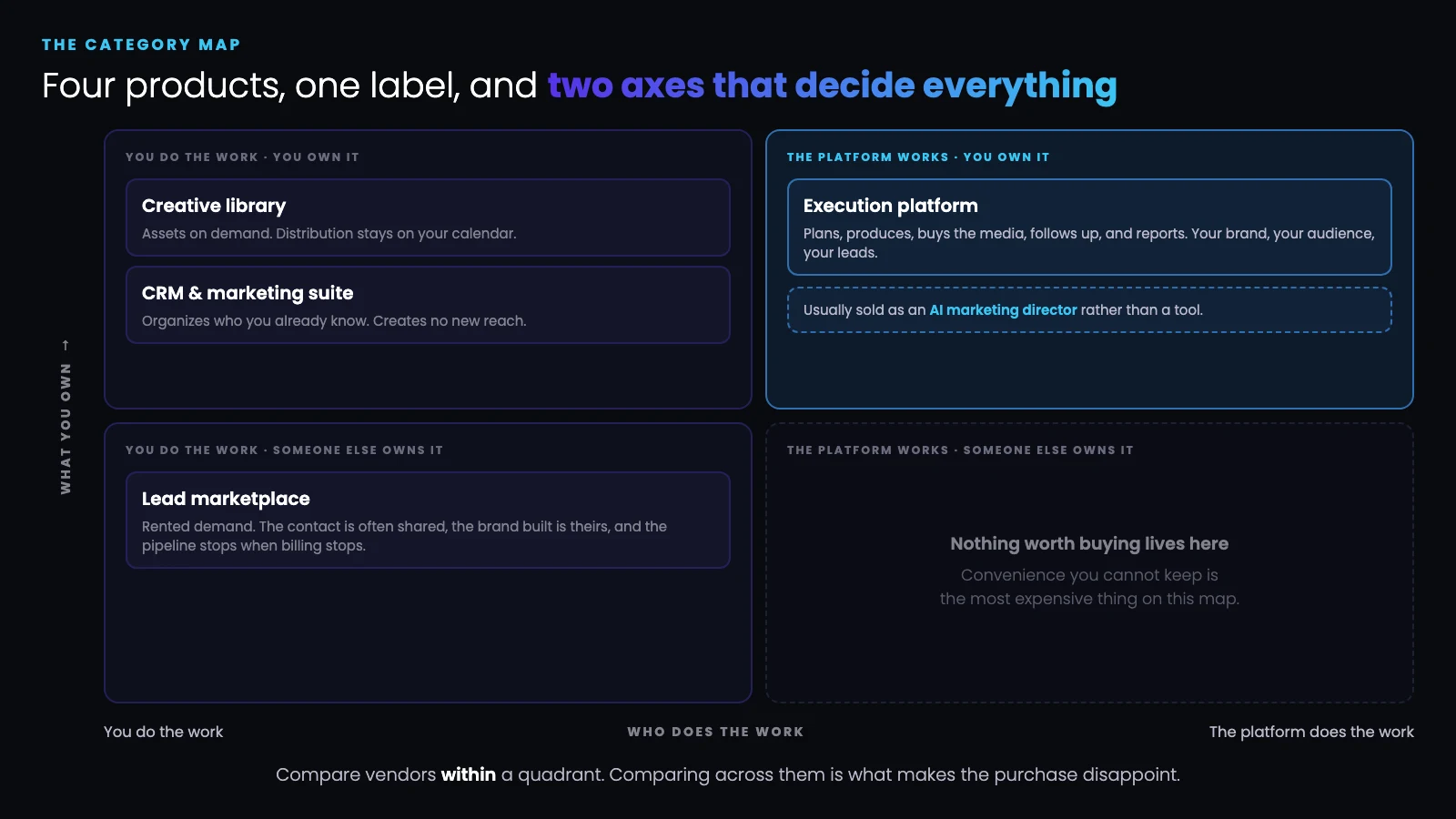
- Four different product categories use the label: lead marketplaces, creative libraries, CRM and marketing suites, and execution platforms. They differ on two axes that matter far more than features — who does the work, and who owns the result.
- Marketing has seven jobs: plan, create, distribute, land, follow up, measure, repeat. Whatever the platform does not do, you do. Score vendors on how many jobs they perform, not how many they support.
- The single most revealing question in any demo is “after I approve this, what happens without me touching it again?”
- Ownership compounds and rented demand does not. A platform that builds your own audience and your own brand is worth more in year two than one that stops the moment you stop paying.
What is a real estate marketing platform?
A real estate marketing platform is software that plans, produces, distributes, and measures marketing for real estate professionals in one connected system, rather than requiring you to assemble those steps from separate tools.
The important word is connected. A design tool makes a flyer. An ad account places an ad. A CRM stores the contact. None of them knows what the others did. A platform earns the name when the plan, the creative, the media, the landing experience, the follow-up, and the reporting all reference the same thing — your listings, your contacts, your market, your budget.
Beyond that shared definition, the category splits hard.
The four kinds of real estate marketing platform hiding behind one name
| Lead marketplaces | Creative libraries | CRM and marketing suites | Execution platforms | |
|---|---|---|---|---|
| What you get | Contacts | Assets | Storage and outbound email | A running marketing program |
| Who does the work | The vendor sells, you chase | You | You, with reminders | The software |
| Who owns the audience | The marketplace | You | You | You |
| Whose brand grows | Theirs | Yours, if you post it | Yours | Yours |
| What stops when you stop paying | Everything | Your template access | Your database access | The programs, but the audience and brand remain |
| Skill required | None | Design sense | Systems thinking | None — plain English |
Lead marketplaces rent you demand. They are the fastest to show a result and the slowest to compound: the contact is often shared with competitors, the consumer’s relationship is with the portal, and the day you pause billing the pipeline goes to zero. There is a reason most bought real estate leads never convert — you are meeting someone who was never looking for you.
Creative libraries solve a real problem, narrowly. You get on-brand flyers, listing graphics, and social templates. What they cannot do is decide what to promote, put budget behind it, or notice that the post underperformed. They shorten production and leave distribution entirely on you.
CRM and marketing suites organize what you already have. They are genuinely valuable for pipeline hygiene and sphere email, and they are frequently mistaken for marketing platforms because they contain a marketing tab. But a drip sequence to your existing database is not reach. It touches the people you already know and does nothing about the people you don’t.
Execution platforms are the newest category and the one the phrase increasingly means. Instead of handing you capability, they perform the work: they build the plan, produce the creative, buy the media across channels, follow up with inbound inquiries, and report on what closed. This is the category Evocalize sits in, and it is usually described as an AI marketing director rather than a tool, because you direct it the way you would direct a hire.
None of these four is wrong. They are answers to different questions. The mistake is buying one while shopping for another.
What should a real estate marketing platform actually do?
Marketing, stripped to its mechanics, is seven jobs in a loop. Whatever a platform does not do, someone does — and in a one-agent business, that someone is you at 9:40pm.
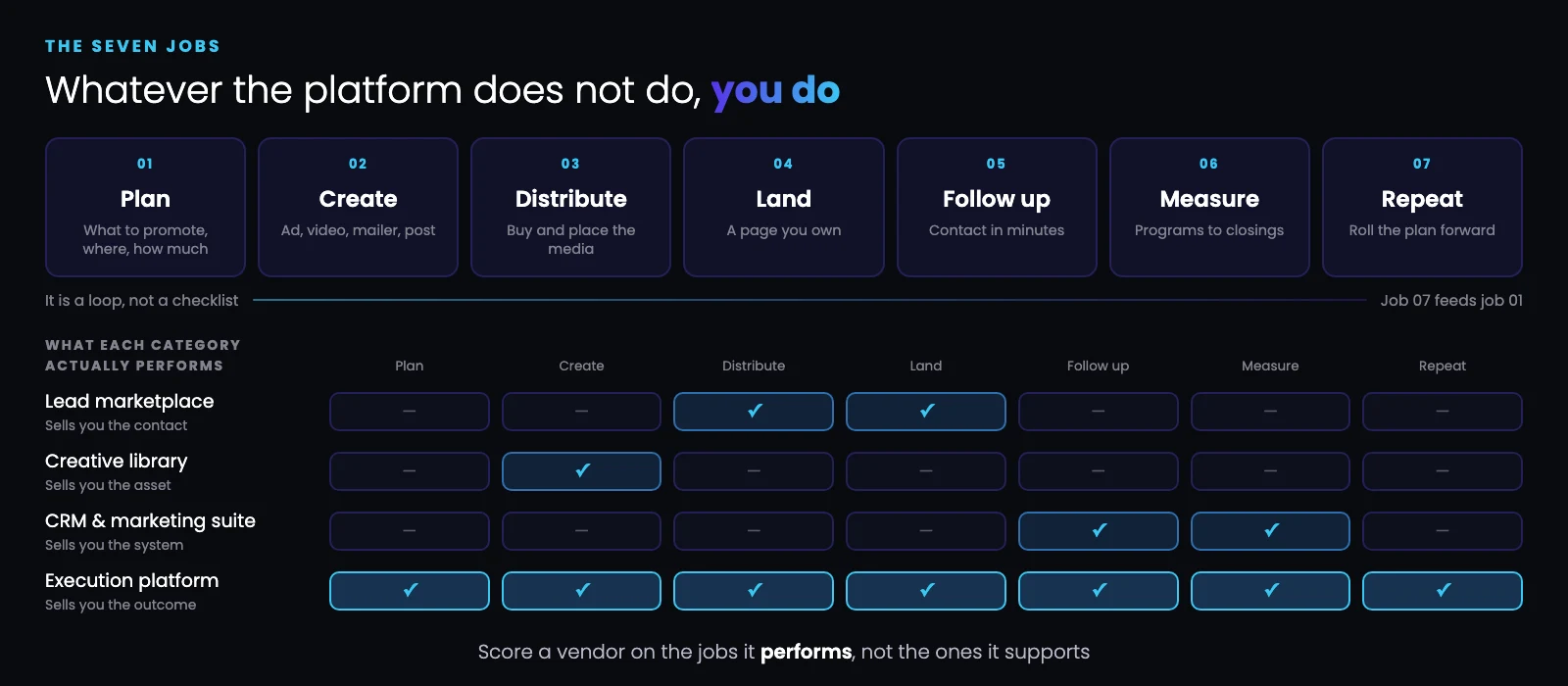
- Plan. Decide what to promote this month, to whom, in what geography, with how much budget. Most agents skip this step entirely and promote whatever is most urgent.
- Create. Produce the ad, the video, the mailer, the post. Listing photos should become listing video without a production day.
- Distribute. Buy and place the media where housing attention actually is: Google search, Facebook and Instagram feeds and stories, YouTube, and the mailbox.
- Land. Send the click somewhere you own. A click that lands on a portal profile is a lead you rented.
- Follow up. Contact the inquiry in minutes, not hours. This is where most real estate marketing spend dies.
- Measure. Attribute results to programs, and ideally to closings rather than clicks.
- Repeat. Roll the plan forward next month, informed by what just happened.
Ask a vendor to walk you through all seven. Almost every product in this market performs two or three of them well and supports the rest, which is vendor language for “you do it.” The gap between supports and performs is the entire buying decision.
Real Estate CRM Marketing: How to Re-Engage Your Database Online
Which type do you actually need?
The right category depends less on your budget than on what is currently scarce for you.
- You are a solo agent with no time. Time is your constraint, not ideas. A creative library will hand you more things to do. You need an execution platform that runs without your attention, or you will buy software and keep not marketing.
- You are a team lead with inconsistent lead flow. Your problem is that marketing stops whenever you get busy, which is exactly when the pipeline for 90 days out is being built. Always-on programs beat heroic bursts.
- You are a brokerage or franchise marketing director. Your constraint is scale and brand control across agents who will not log into anything twice. You need a platform that pushes compliant, on-brand programs down to agents and reports up — and adoption, not features, is your real success metric.
- You are a new agent building a sphere from scratch. You need reach to people who don’t know you yet, plus a destination that makes you look established. A CRM alone has nothing to organize yet.
- You genuinely enjoy running ads. Then the DIY route is real, and a creative library plus your own ad accounts is a legitimate stack. Be honest about whether you will still be doing it in month seven.
One framing that cuts through most of this: are you trying to get leads or build a pipeline you own? Rented demand answers the first question, and only the first. Competing with the portals locally is a different exercise than buying from them.
What does it look like when the platform does the work?
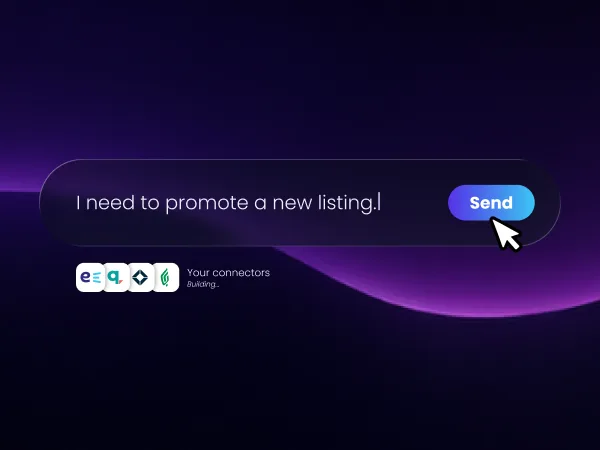
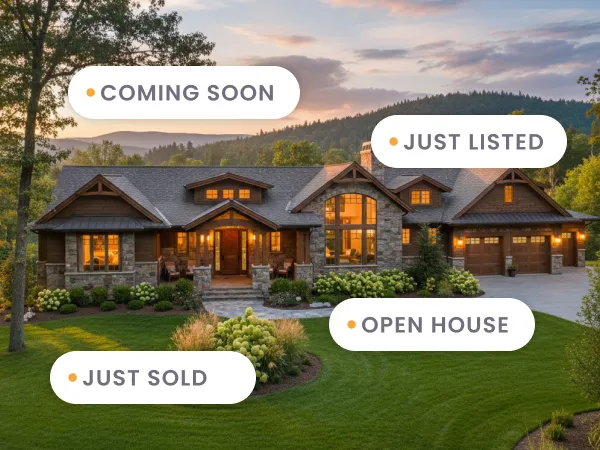
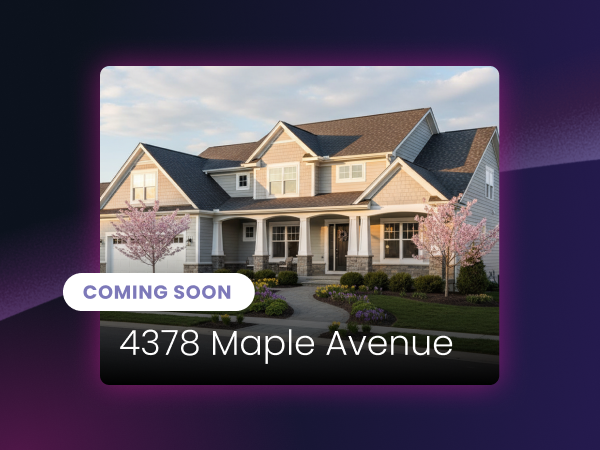
The practical difference shows up in what happens after approval. On an execution platform, you describe an outcome in plain English — “just listed 4128 Maple Ave,” “fill Sunday’s open house,” “I need more buyer conversations this fall” — and the platform returns a complete program: the audience, the creative, the channel mix, and a budget recommendation. One approval launches all of it.
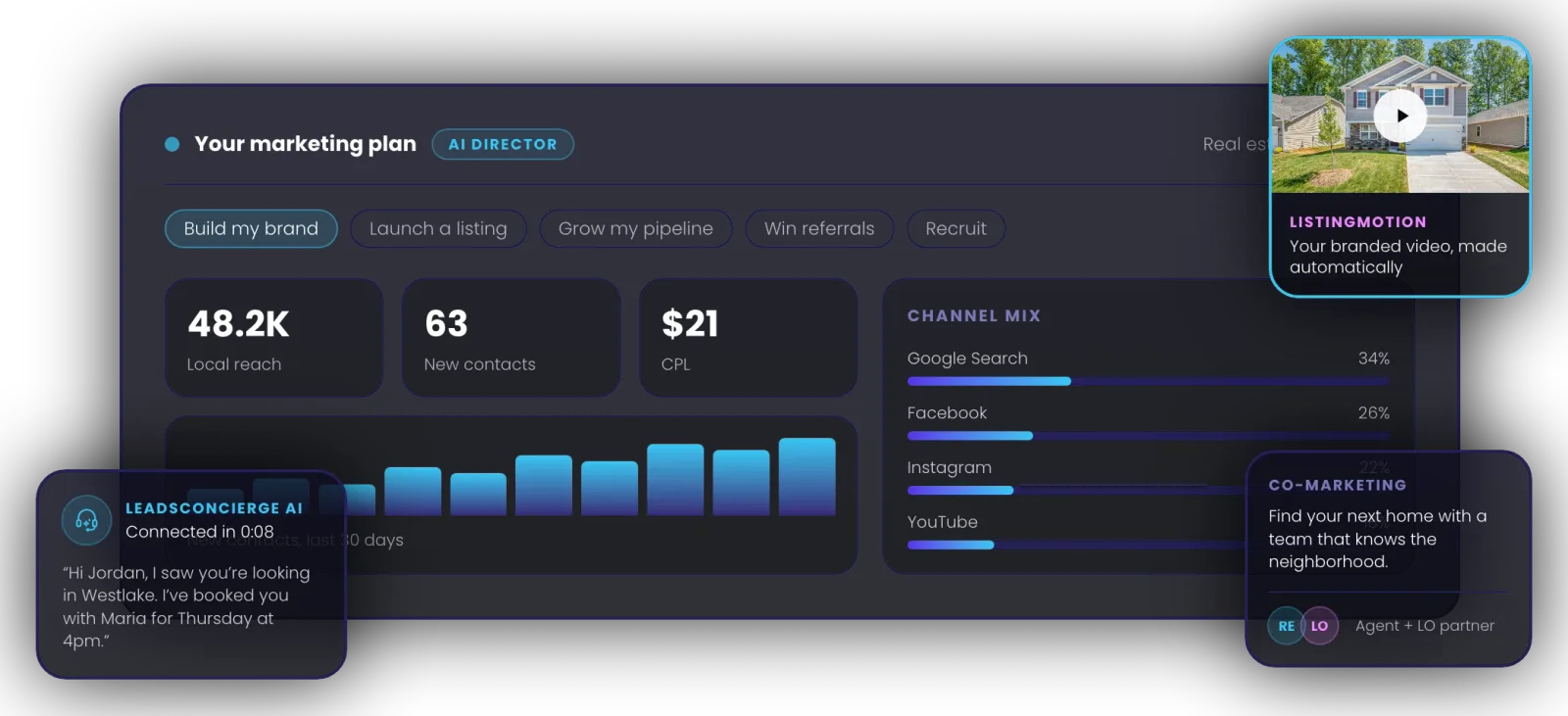
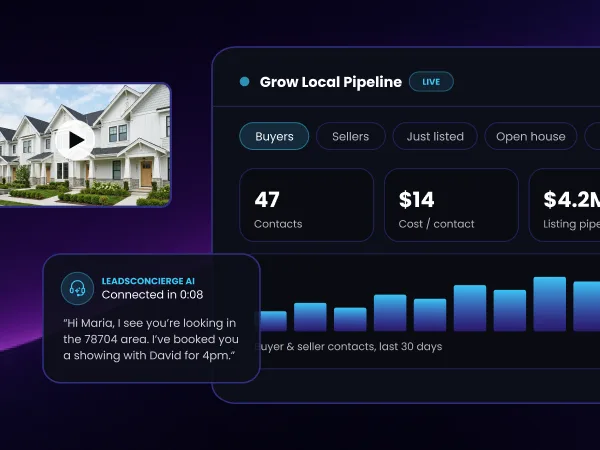
From there it keeps going without you. ListingMotion turns listing photos into branded video automatically. SmartSite gives every property a page you own, so clicks land on your brand instead of a portal profile. New inquiries get contacted within seconds rather than waiting for you to come out of a showing. Budgets shift toward what is working, and the plan rolls forward into next month on its own.
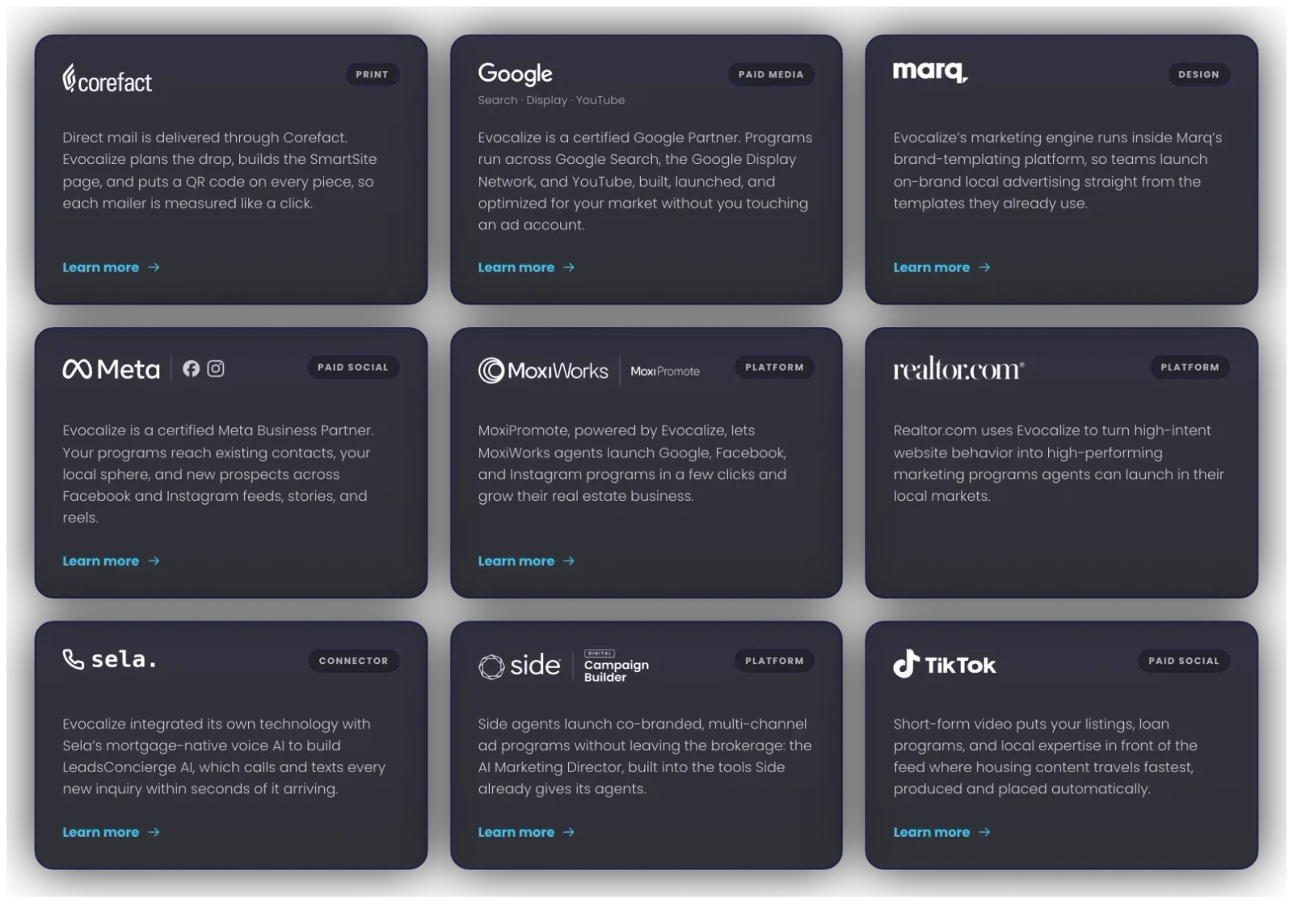
The other thing a real platform does is start from what you already have. Programs should launch against your existing contacts, your local sphere, and new prospects at equal weight — using your CRM data, your listings, and your brand, with nothing to rip out.
What results does a real estate marketing platform produce?
Numbers from real estate professionals running Evocalize programs, drawn from real programs rather than projections:
1,335% ROI
$3,064 in programs turned into $44,000 in commissions by acting on new inquiries within five minutes.
 Jasmina Law
eXp Realty
Jasmina Law
eXp Realty
153 inquiries
54,900 impressions and 1,200 clicks from listing ads, without babysitting them all day.
 James Hemphill
eXp Realty
James Hemphill
eXp Realty
<$20 CPL
333+ potential buyers on a $750/month budget, running on autopilot for a year.
 Terri Dennis
eXp Realty
Terri Dennis
eXp Realty
What these have in common is not budget size or market. It is that the programs ran continuously. The $750-a-month program that ran for twelve months beat plenty of larger budgets that ran for six weeks and stopped, because reach compounds and audiences do not reset.
How do you evaluate a real estate marketing platform before you buy?
Take these nine questions into every demo. They are ordered so that the first three usually settle it.
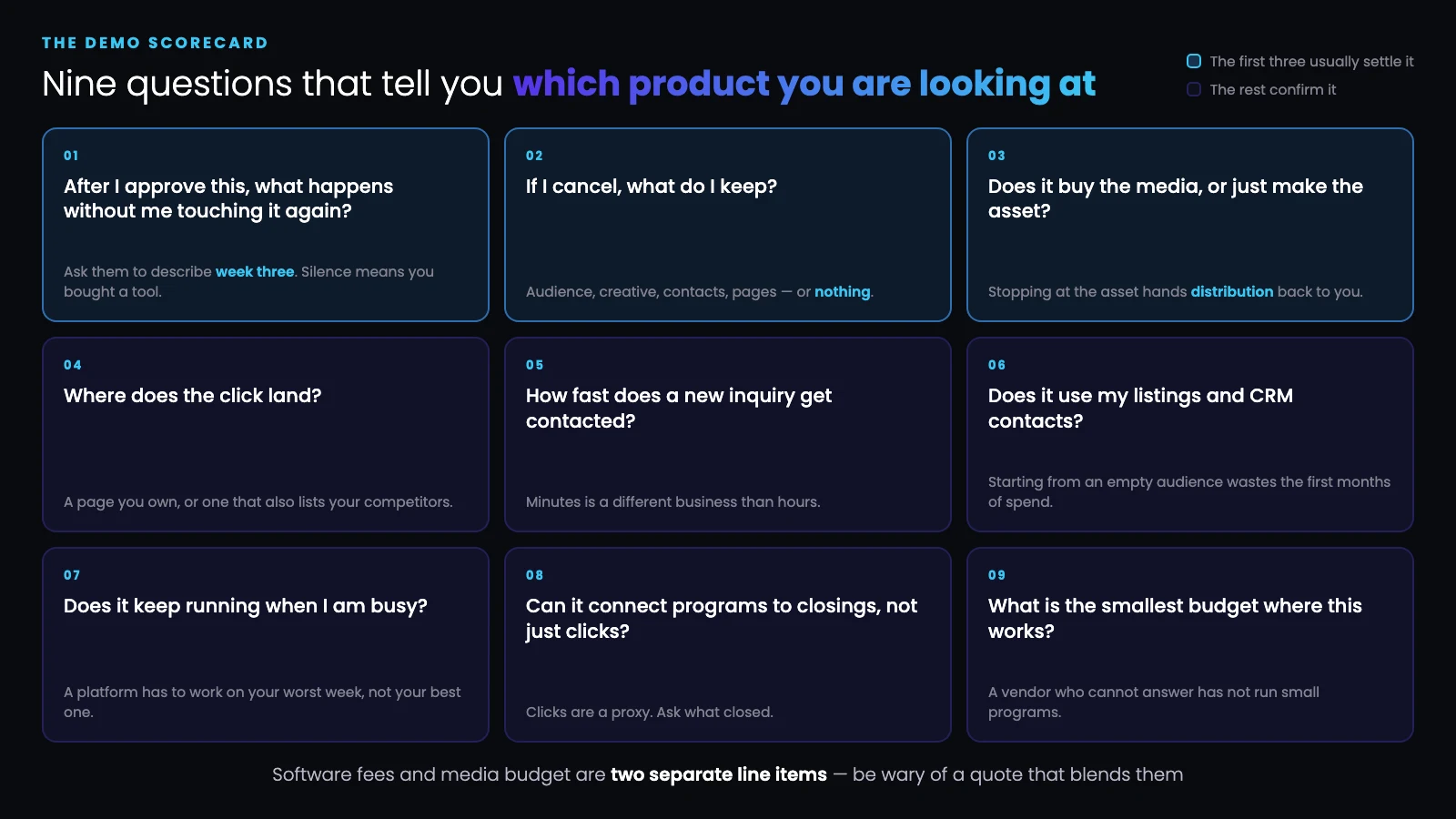
- After I approve this, what happens without me touching it again? Ask them to describe week three. Silence here means you bought a tool.
- If I cancel, what do I keep? Your audience, your creative, your contacts, your pages — or nothing.
- Does it buy the media, or just make the asset? A platform that stops at the asset has handed job three back to you.
- Where does the click land? A page you own, or somewhere that also lists your competitors.
- How fast does a new inquiry get contacted? Minutes is a different business than hours. Speed is the highest-leverage variable in the entire loop.
- Does it use my listings and my CRM contacts, or start from an empty audience? Starting from zero wastes the first months of spend.
- Does it keep running when I’m busy? The point of a platform is that it works on your worst week, not your best one.
- Can it connect programs to closings, not just clicks? Clicks are a proxy. Ask what closed.
- What is the smallest budget where this works? A vendor who cannot answer this has not run small programs.
Two cost notes worth knowing before the pricing conversation. First, software fees and media budget are separate things — a low subscription with no media behind it produces nothing, and a vendor bundling them opaquely is worth questioning. Second, the honest payback window for pipeline work is six to twelve months, not six weeks. Listing promotion produces inquiries fast; brand and sphere programs compound. Budget for the compounding or you will quit right before it starts.
For context on why the always-on version wins: buyers now begin their search long before they contact anyone, and 82% of Americans already use AI for housing market information, according to a Realtor.com survey. The National Association of REALTORS® research library tracks the same shift in its annual buyer and seller profiles. Visibility during that research window is not a campaign you run in March. It is a program that never turns off.

FAQs
What is a real estate marketing platform?
It is software that plans, produces, distributes, and measures marketing for real estate professionals in one connected system. The strongest versions also execute — buying the media, following up with inquiries, and rolling the plan forward — instead of handing those steps back to the agent.
Is a real estate CRM the same as a real estate marketing platform?
No. A CRM organizes the relationships you already have and can send email to them. A marketing platform creates reach to people who are not yet in your database, and buys the media to do it. Most successful setups use both, with the marketing platform pulling CRM contacts in as audiences.
Do I still need to buy leads if I have a marketing platform?
Many agents run both during a transition, then taper the purchased leads. The difference is what you are left holding: bought leads stop the day billing stops, while an owned audience and a recognized local brand keep working. The economics usually favor shifting spend from rented demand to owned programs over the first year.
How much does a real estate marketing platform cost?
Expect two line items: a software subscription and a media budget. Meaningful local programs commonly run in the several-hundred-dollars-a-month range for media, and results in this market have come from budgets as modest as $750 a month sustained over a year. Be skeptical of any quote that does not separate the two.
How long before a real estate marketing platform produces results?
Listing and event promotion can generate inquiries within the first couple of weeks. Pipeline transformation takes six to twelve months, because audiences, brand recognition, and remarketing pools compound. The professionals who see outsized returns are almost always the ones who let programs run continuously rather than starting and stopping.
Will an AI marketing platform replace my role as an agent?
No. It takes over the coordination work — deciding, producing, launching, monitoring — that most agents either skip or do inconsistently. Negotiation, local judgment, and client relationships stay yours, and they are what the marketing exists to feed.
See what a platform that runs your marketing looks like
If you are shopping this category, the fastest way to tell the four types apart is to watch one of them actually build a plan and launch it.