A year ago, nearly one in three homebuyers said they trusted AI tools to help them find a home. Today, that number has been cut nearly in half — down to 16%. That’s not a rounding error. That’s a collapse in confidence happening in real time, right as AI in real estate marketing is becoming nearly impossible to avoid.
The irony?
Buyers haven’t stopped expecting AI. Three in four now assume it’s already running somewhere inside the homebuying process. What’s changed is what they’re demanding from it: accuracy, transparency, and a clear human hand on the wheel.
For real estate agents and loan officers, this creates both a warning and an opportunity. The professionals who treat AI as a shortcut to more content will lose trust faster than they realize. The ones who use it as a tool that amplifies their human expertise — while staying visible, consistent, and accountable — are the ones who will win the next three years.
This post breaks down what buyers actually want, where AI marketing is going wrong, and what responsible use looks like in practice.

Key takeaways
- Buyer trust in AI for homebuying dropped from 30% to 16% in one year — familiarity created higher standards, not more comfort.
- 70% of homebuyers across all age groups consider AI-produced errors unacceptable, making accuracy a non-negotiable baseline.
- 68% of buyers want clear disclosure when AI is involved in their homebuying process — and that expectation is growing.
- The agents and loan officers winning with AI aren’t using the most of it. They’re using it most responsibly — letting it handle optimization and targeting while showing up personally for the moments that matter.
- AI in real estate marketing works best as a background engine: running programs, qualifying leads, and optimizing spend while the professional handles the relationship.
What the data actually says — and what it means for you
Research published in early 2026 from Cotality surveyed homebuyers across the U.S., Canada, the UK, and Australia and found something striking: trust in AI has declined precisely because it became ubiquitous. Buyers aren’t unfamiliar with AI. They’re evaluating it the same way they evaluate any infrastructure — by whether it’s accurate, transparent, and recoverable when it goes wrong.
The numbers that matter most aren’t the ones about adoption. They’re the ones about what buyers actually do when AI shows up in the process:
- 44% say they would pay more to have a human verify AI-generated recommendations before acting on them.
- 64% worry that AI may “recycle” unverified information in ways that affect their decisions.
- 46% say lenders or insurers shouldn’t conduct AI valuations without prior approval.
This isn’t a generational story, either.
Millennials are the heaviest AI users in the homebuying process — and also the most likely to invest in human verification of AI outputs. Gen Z respondents said AI involvement actually increased their confidence when buying, largely because they expected it to speed up the process. But even they drew clear lines around accuracy and disclosure.
The takeaway isn’t that AI has lost its value in housing. It’s that the honeymoon phase is over. Buyers are no longer impressed by AI’s existence. They’re now grading it — and they have high standards.

Why AI marketing in real estate is going wrong
The trust gap isn’t theoretical. You can see the symptoms everywhere. LinkedIn feeds full of posts that read identically. Listing photos with impossible lighting, suspiciously smooth countertops, and grass that looks too green to be real.
The problem isn’t quality alone. It’s authenticity. One brokerage executive put it plainly in a Real Estate News article: buyers are starting to question whether the person they’re hiring is actually doing the work, or whether their entire online persona has been outsourced to a machine. In a business built on trust, that doubt is expensive.
There’s a second failure mode that’s subtler but more damaging: using AI where a human moment was required. AI-generated follow-up emails that don’t reference the actual conversation. Automated responses that misread the prospect’s timeline. Content that answers the generic question instead of the specific one the buyer asked.
The agents who struggle with AI in real estate marketing aren’t the ones who use it too much. They’re the ones who use it in the wrong places — front and center in situations where personal, specific, human judgment is exactly what the client is paying for.
What buyers actually want from AI (it’s not less of it)
Here’s what the data makes clear: buyers don’t want AI removed from real estate. They want it used honestly.
The expectation that AI is already present is nearly universal. What buyers are asking for is:
- Disclosure. 68% say they want clear notification when AI is involved in producing the outputs they’re relying on. That includes property valuations, mortgage recommendations, and marketing materials that influence their decisions.
- Verification. More than two-thirds say they would manually verify “a significant amount” of anything an AI tool provides in a housing context. Nearly half say they’d pay extra for a professional to do that verification for them.
- Accountability. Buyers want to know that a human reviewed what the AI produced before it shaped a decision that affects their finances or their family.
This framing is useful for agents and LOs because it redefines what “responsible AI use” actually means. It doesn’t mean using less AI. It means being clear about when AI is present, building human review into the process, and showing up personally for the moments where your judgment — not an algorithm’s — is what the client is relying on.

Will AI Replace Real Estate Agents? Why the 1% Trust Gap Matters More Than You Think
4 rules for AI in real estate marketing that doesn’t erode trust
1. Let AI run in the background — not front and center
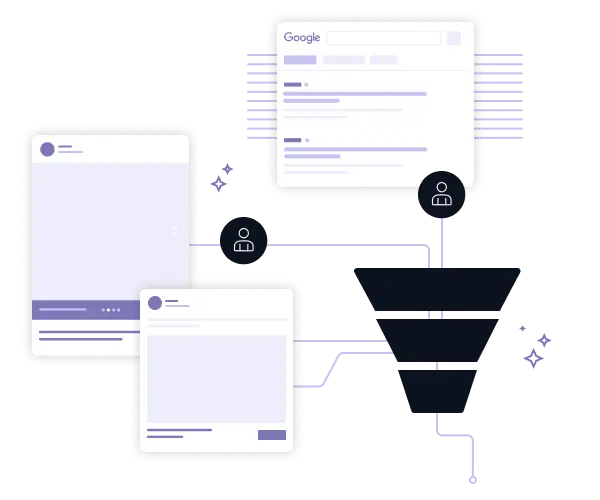
The strongest use cases for AI in real estate marketing are the ones buyers never see: targeting the right audience, optimizing ad spend across channels, scoring leads by purchase intent, and adjusting bids in real time. These tasks don’t require your voice or your face. They require processing power and pattern recognition.
Where AI should not be the primary author is in anything that represents your relationship with a specific client — follow-up messages after a conversation, responses to specific questions about a property, or content that speaks to a buyer’s individual situation.
Let the AI do what it does better than humans. Do what only you can do.
2. Be transparent when AI is involved
Disclosure doesn’t have to be awkward or legalistic. It can be as simple as a line in your email signature noting that some communications are AI-assisted, or a note on your listing materials that your team uses AI-powered marketing tools.
What buyers respond poorly to is discovering AI was involved without being told. That feels like concealment — and in housing, where financial stakes are high, concealment destroys trust faster than almost anything else. Getting ahead of disclosure now, before it becomes a regulatory requirement, positions you as a professional who takes your clients’ confidence seriously.
3. Never use AI where a human moment is required
The highest-stakes interactions in a real estate or mortgage transaction are deeply human. Negotiating an offer. Calming an anxious first-time buyer at 10 PM. Explaining why a deal fell through. Helping a family figure out what they can actually afford.
These moments are where your value is irreplaceable — and where AI-generated language lands with a hollow thud. An automated response to a genuine question signals that you’re not really paying attention. In a transaction this large, that’s a relationship-ending signal.
Protect these moments. Use AI to free up your time so you can be fully present for them.
4. Verify before you publish
AI-generated content makes errors. It confuses market statistics. It occasionally fabricates citations. It uses outdated data. In real estate marketing, an incorrect claim about a neighborhood, a school district, or a property feature doesn’t just embarrass you — it can expose you to liability.
Every piece of AI-generated content that touches a client should go through a human review before it goes out. This applies to listing descriptions, market update emails, social media posts, and any content that makes factual claims. Your name is on it. Make sure it’s right.

Real Estate Agent Skills to Learn in the Age of AI
What responsible AI marketing actually looks like
The agents and loan officers seeing the strongest results from AI-assisted marketing share a common pattern: AI handles the work that runs in the background, and they show up for everything visible.
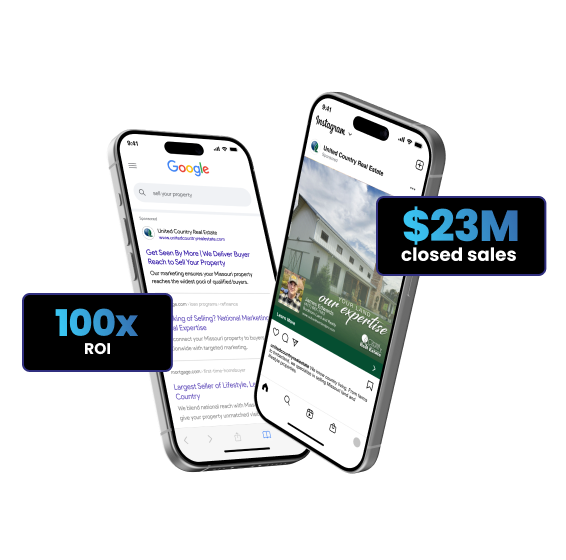
James Edwards, a land and rural real estate agent, spent around $500 a month running listing promotion and brand awareness marketing programs through Evocalize. Over 12 months, that $6,000 in marketing investment helped generate $23 million in closed sales — a 100x return.
But what made the difference wasn’t the ad volume. It was the flywheel: every listing he promoted didn’t just sell faster, it attracted new seller clients. Buyers became sellers. The AI optimization running behind every program identified who was most likely to convert and adjusted in real time. James focused on the relationships. The system handled the rest.
Another loan officer using Evocalize ran brand awareness and sphere-targeting programs for about a year in the Chicago market. The result: roughly 70 loan applications from $5,100 in total spend — an estimated 5x return.
His take: “There are a lot of LOs out there. I need to stand out. That’s where Evocalize comes in.” The AI-powered programs kept him visible across Google, Facebook, and Instagram consistently — not in bursts when he had time, but continuously.
This is the model that earns trust: AI as a background growth engine, professional as the face clients actually call.
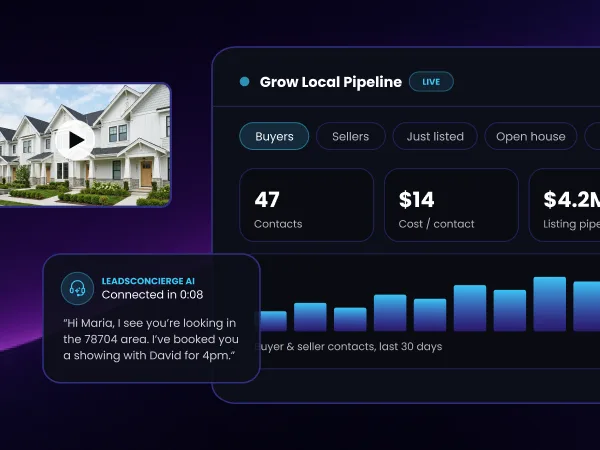
Evocalize is built for exactly this approach. Its AI-powered marketing programs — which run across Google, Facebook, Instagram, and more — optimize for higher-intent leads automatically, with built-in compliance guardrails and industry-specific templates reviewed by housing professionals. The Leads Intelligence system scores every lead in real time and teaches the ad platforms to find more of the right prospects. Leads Intelligence doubles higher-intent leads while reducing low-quality leads by 34%.
FAQs
Is it legally required to disclose when AI creates my real estate marketing content?
Disclosure requirements vary by state and are evolving fast. Some states, including California, have begun implementing disclosure rules around AI-generated marketing materials in real estate — particularly for listing photos and videos.
Beyond legal requirements, the practical case for disclosure is strong: buyers who discover undisclosed AI use report significantly lower trust in the platform or professional involved. Getting ahead of disclosure protects your reputation regardless of jurisdiction.
How do I use AI in real estate marketing without my content sounding generic?
The key is specificity. AI produces generic content when given generic inputs. Before generating any content, give your AI tool specific context: your market, your target buyer profile, the specific property details, recent neighborhood activity, or the actual conversation you had with a prospect. The more specific your prompt, the more specific the output. Then edit it in your voice before it goes anywhere near a client.
What’s the difference between AI that helps my brand and AI that hurts it?
AI helps your brand when buyers never see it working — it’s optimizing your ad spend, scoring inbound leads, and keeping your marketing programs running consistently. AI hurts your brand when it’s the face of your client relationship: generic email responses, listing descriptions that don’t match the actual property, or content that sounds like it could have been written for any agent in any market. The test: would your best client recognize this as yours?
Can I use AI for lead follow-up without losing the personal touch?
Yes — with a clear handoff point. AI tools that respond within seconds of a lead submission, answer basic questions about the property, and qualify intent are genuinely valuable (leads contacted within 5 minutes are 100x more likely to connect). But the moment the conversation moves toward a real decision — the buyer’s timeline, their financing situation, their specific concerns — a human needs to be in that conversation. Set the handoff trigger clearly, and hold to it.
Should loan officers and real estate agents use the same AI marketing approach?
The channels and content types differ, but the principle is the same. For loan officers, AI works best for keeping you visible during the 6-to-12-month window before a borrower is ready to act — running consistent programs across Google and social that build familiarity before the decision point.
For agents, AI drives listing promotion and local brand awareness that compounds over time. In both cases, the AI handles the consistency problem. You handle the conversion conversation.
The digital marketing growth engine for real estate
The agents and loan officers who will win the next three years aren’t the ones with the most AI tools. They’re the ones whose clients trust how they use them.
See how Evocalize helps real estate professionals grow with AI that runs in the background and compliance built in from the start.