The question keeping agents up at night: will AI replace real estate agents?
If you’ve been watching ChatGPT dominate headlines and seeing companies like Zillow integrate AI search tools, the anxiety makes sense. But here’s what the data actually shows: while 82% of Americans now use AI for housing market information, real estate agents remain the most trusted source for making people feel “smarter” about the market—but barely.
Let’s be honest about what the numbers really say.

The one percent that matters (and the honest truth about the gap)
A recent Realtor.com survey found that 62% of homebuyers said real estate agents make them feel smarter about the market. AI came in at 61%.
One percentage point.
If you’re looking at that data and thinking “that’s basically a tie,” you’re not wrong. AI is closing in fast, and pretending otherwise is naive. The question isn’t whether AI is getting better at providing housing information—it obviously is. The question is whether being good at providing information is the same thing as being good at being a real estate agent.
It’s not.
Here’s the distinction that matters: AI excels at delivering data. Agents excel at applying judgment to that data in a specific context for a specific client.
Think about what homebuyers actually face. They’re comparing mortgage rates, analyzing neighborhood trends, and trying to time their offer in a market that shifts weekly. AI can surface comparable sales data in seconds. But AI can’t tell you whether that specific seller is motivated enough to accept a lower offer. It can’t read the body language during a showing when the listing agent lets something slip about timing. It doesn’t negotiate on your behalf when three other buyers submit offers on the same day.
The role of AI is information retrieval and pattern recognition. The role of a real estate agent is contextual judgment and strategic execution. These aren’t competing functions—they’re complementary. And here’s why that distinction matters more than the statistical near-tie in the survey data.
Why better-informed buyers need agents more, not less
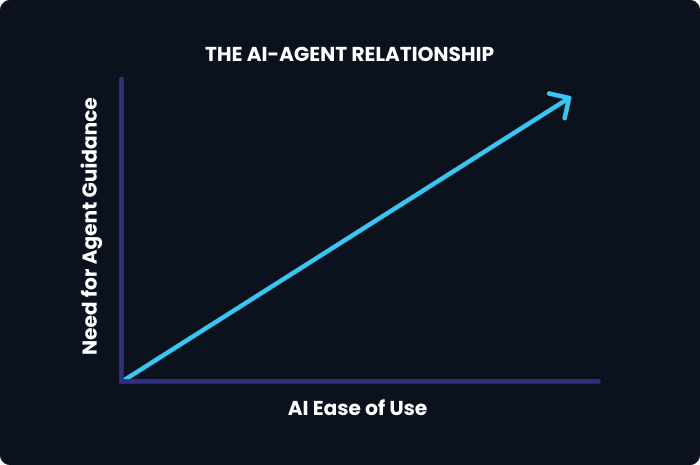
Here’s the paradox nobody’s talking about: as AI makes housing research easier, the need for expert guidance actually increases.
When buyers arrive at your door having already consumed hours of AI-generated market analysis, they’re not less in need of your services. They’re more confused about what to do next. They’ve educated themselves on the basics—now they need someone who can help them act on that information in their specific situation.
Consider the now typical homebuyer journey. They’ve asked ChatGPT about mortgage rates. They’ve watched YouTube videos about the process. They’ve scrolled through Facebook groups reading other buyers’ war stories. They’ve saved dozens of properties and run the numbers through every affordability calculator they could find.
Then they realize: none of this tells them whether this specific house in this specific neighborhood at this specific price point is actually the right move for them right now.
That’s the gap AI can’t close. Not because the technology isn’t sophisticated enough, but because the question itself requires human judgment about risk tolerance, lifestyle priorities, and timing decisions that involve dozens of variables AI generally doesn’t weight properly. Should you wait for rates to drop? Should you expand your search radius? Is this seller desperate or just testing the market? These aren’t data problems. They’re judgment calls that require understanding context AI doesn’t have access to.
So will AI replace real estate agents? Here’s the honest answer
Could AI eventually get so good at mimicking human judgment that it closes the 1% gap and surpasses agents entirely? Maybe. But that’s asking the wrong question.
The right question is: what happens when both AI and human agents get better simultaneously? Because that’s what’s actually happening. AI is getting more sophisticated at information synthesis. And smart agents are getting better at leveraging AI tools to enhance their own effectiveness.
The future isn’t “AI or agents.” It’s “AI-enhanced agents versus agents who refused to adapt.” And we already know how that story ends.
Here’s what the data actually predicts: a future where AI handles everything that can be standardized—pulling comps, explaining loan types, answering basic questions about the process. Meanwhile, agents focus exclusively on what requires human insight: reading between the lines of a listing description, knowing which inspector won’t miss foundation issues, understanding local market dynamics that don’t show up in any database.
Real estate is hyperlocal. Your market might be heating up while the national headlines scream about a slowdown. Your neighborhood might have quirks—a planned development, a school district change, a zoning variance—that no AI model has context to evaluate properly. This hyperlocal, ground-level knowledge is your competitive advantage, and it’s one that AI struggles with fundamentally because it operates on patterns, not on the specific exception happening in front of you right now.
The smarter response: embrace AI as your marketing advantage
If you’re worried about whether AI will replace real estate agents, you’re asking the wrong question. The better question: how can you use AI to become the agent that buyers choose over your competition?
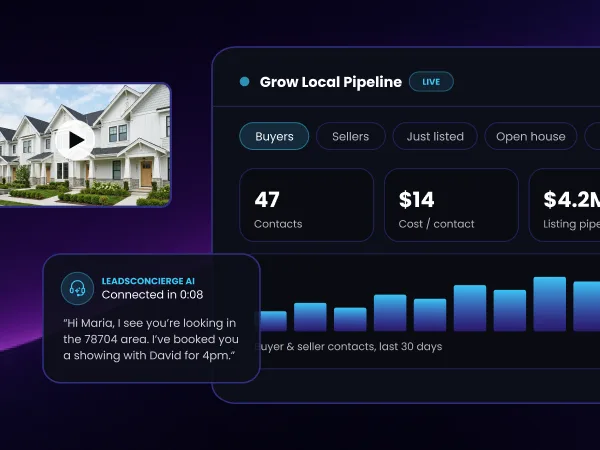
Smart agents are already using AI to amplify their expertise, not replace it. They’re using AI-powered marketing platforms to stay visible in a crowded market. They’re leveraging automation to respond faster to leads. They’re using data analytics to identify which buyers are serious and which are just browsing.
At Evocalize, we’ve seen this evolution firsthand working with thousands of real estate professionals. Our platform uses AI to help agents generate quality leads through sophisticated digital marketing—that’s push-button easy. But the AI doesn’t replace the agent. It makes the agent more effective by handling the technical complexity of multi-channel campaigns, freeing up time for what actually closes deals: building relationships and providing expert counsel.
The agents thriving in today’s market aren’t the ones resisting AI. They’re the ones figuring out how to use it strategically while doubling down on the parts of their job that AI can’t touch: trust-building, negotiation, and deep local market expertise.

Lead follow-up strategy for mortgage and real estate: 4 tips for success
The bottom line
Will AI replace real estate agents? Probably not—but it will absolutely change what being a successful agent looks like.
The agents who survive the next decade will be those who understand that AI is a tool for efficiency, not a replacement for expertise. They’ll use AI to handle the commodity work—lead generation, content creation, market research—while focusing their human energy on high-value activities that require judgment, empathy, and local knowledge that comes from actually working in a market every day.
The 82% of buyers using AI for housing research aren’t abandoning agents. They’re arriving better informed and more prepared to have sophisticated conversations about strategy. They want both: the speed and accessibility of AI information gathering combined with the wisdom and advocacy of a skilled professional who knows their specific market intimately.
Your job isn’t to compete with AI on information delivery. That’s a race you’ll lose. Your job is to become the trusted advisor who helps buyers make sense of everything AI tells them—and then guides them through the messy, complicated, deeply human process of actually buying or selling a home. That’s a role that will remain valuable for a very long time.