Loan officer marketing is everything an LO does to stay in front of past clients, referral partners, and new borrowers. That means local visibility, co-marketing with agents, outreach to your sphere, and fast follow-up on every inquiry.
For years, the loan officer did all of it alone. They picked what to run, built the flyer, set up the audience, checked the dashboard, and chased the inquiry that came in during a closing. The work got done, but it was done by the most expensive person in the building.
That is changing. An AI marketing director now does the work, and the loan officer directs it: set the goal, approve the plan, and spend the time saved with borrowers and agents.
This post covers where the hours go today, what to hand off and what to keep, and how you stay in charge of your own brand.
Key Takeaways
- Loan officer marketing has shifted from a set of tasks the LO performs to a set of decisions the LO directs, with an AI marketing director doing the planning, building, launching, optimizing, and follow-up.
- An AI marketing director works across the tools a loan officer already uses and coordinates them toward one goal, so the LO stops being the person who connects the ads to the landing page to the CRM by hand.
- The loan officer still owns the goal, the budget ceiling, the brand, the approvals, and the compliance boundaries their lender sets. Everything inside those boundaries can be delegated.
- The hours a director gives back are worth the most when they go to borrower conversations, referral-partner relationships, and closings, the three things only the loan officer can do.
- Evocalize is the AI marketing director for real estate and mortgage professionals. Evo builds and runs the plan, reports what it changed, and asks before anything that needs your approval.
Where Do Loan Officer Marketing Hours Actually Go Today?
Most loan officers do not have a marketing problem. They have a marketing labor problem. The strategy is usually sound: stay visible locally, bring value to referral partners, keep past clients warm, and be the first call when someone is ready to buy. Executing it is a dozen small jobs, and all of them land on the LO.
Here is a typical week, drawn from how the loan officers we work with describe it:
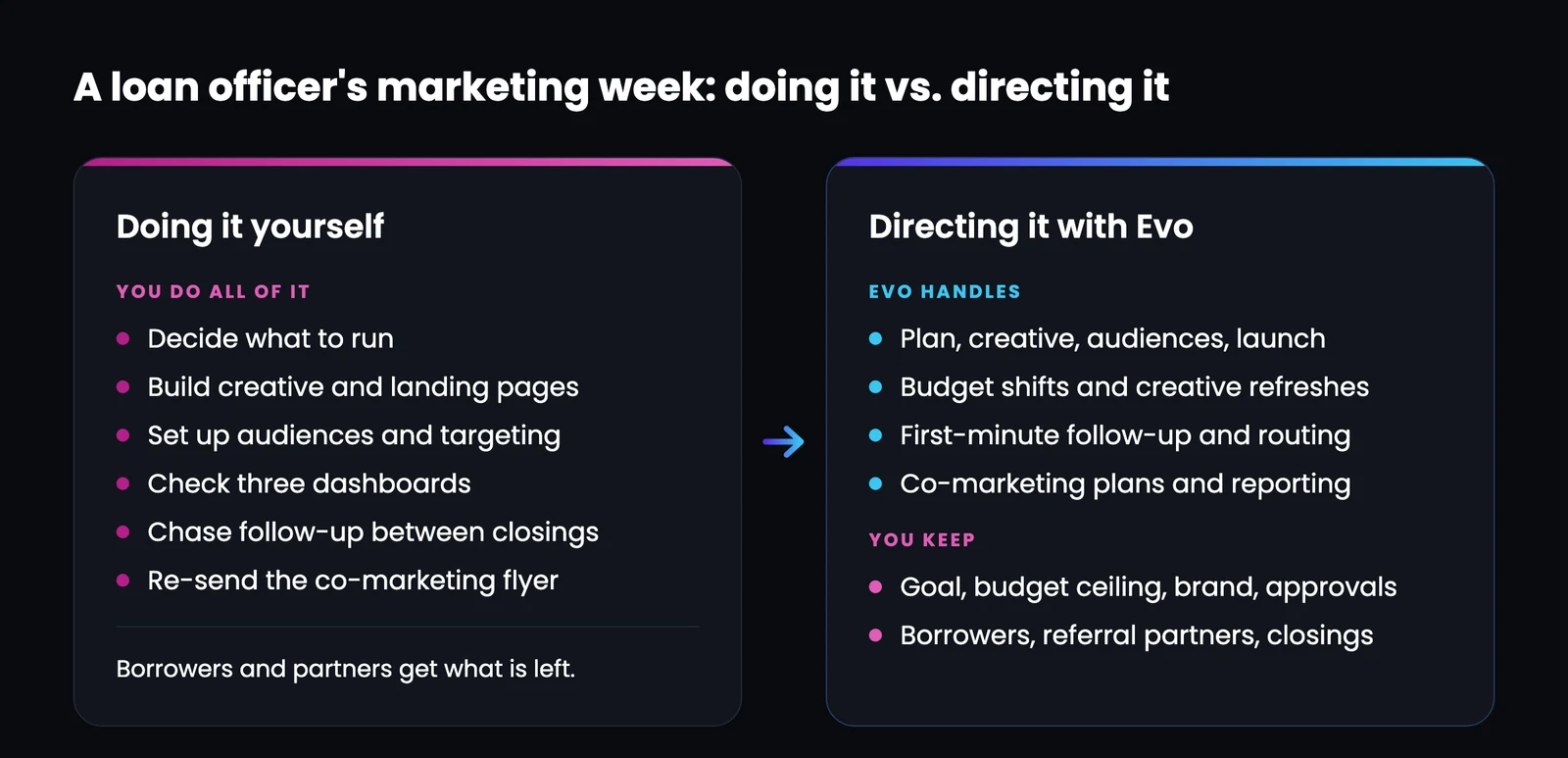
- Choosing what to run. A menu of options and a decision made in the gap between two calls.
- Building creative. A design tool, a compliant headshot and logo, a headline, three export sizes, and a redo when the rate changes.
- Setting up audiences. Uploading a contact list to one platform, rebuilding it on another, and hoping the targeting matches the ad.
- Checking dashboards. The ad account, the CRM, and the email tool, to answer one question: is this working?
- Chasing follow-up. A lead comes in during a closing. By the time the LO calls back, the borrower has talked to two other lenders.
- Re-sending the co-marketing flyer. The same agent, the same template, a new listing, by hand.
None of these tasks is hard. Together they are a second job, and they are the first thing to slip when the pipeline gets busy. That is why so much loan officer marketing runs in bursts: a push in a slow month, silence in a good one, and no compounding in between. We covered the cost of that pattern in why the hustle mentality backfires for loan officers.
What Does It Mean to Direct Loan Officer Marketing Instead of Doing It?
An AI marketing director plans, creates, launches, and optimizes your marketing for you. It works across the tools a professional already uses and coordinates them toward one goal. A tool with an AI button inside it is an assistant. A director runs the whole system.
Evocalize is the AI marketing director for real estate and mortgage professionals. The agent is named Evo. You tell Evo the goal in plain English, and Evo builds the plan, launches it, adjusts it, follows up on what it produces, and reports back on what it changed and why.
Directing, in practice, looks like this:
- You set the goal. “Stay in front of my past clients this winter.” “Build a purchase pipeline in the two zip codes where my agent partners list.” “Promote the first-time buyer seminar on the 14th.”
- Evo builds the plan. The creative, local audiences drawn from your existing contacts, your local sphere, and new prospects, a budget recommendation inside your ceiling, and the channel mix across search, social, your landing experience, email to your sphere, and the follow-up that answers each inquiry.
- You approve it. One approval launches all of it. You see the creative and the budget before anything goes live.
- Evo runs it and tells you what it did. When budget moves between plans, when creative is refreshed because the rate sheet changed, when a lead is routed and called. You get the summary, and you get asked when something needs your decision.
That last step is the whole difference. The loan officer who does their own marketing finds out what happened by logging in. The loan officer who directs it is told, in the moment, and acts only on the exceptions.
What Should a Loan Officer Delegate, and What Should They Keep?
The line is simple: delegate everything that is a task, keep everything that is a relationship or a judgment call.
The table below is illustrative. Your week will look different, and the point is where the hours move, not the exact count.
| Marketing job | Doing it yourself (hrs/week) | Directing it (hrs/week) | Who owns it now |
|---|---|---|---|
| Deciding what to run | 1.5 | 0.25 | You set the goal; Evo proposes the plan |
| Building creative and landing pages | 2 | 0 | Evo |
| Setting up audiences and targeting | 1 | 0 | Evo |
| Checking dashboards and reports | 1.5 | 0.25 | Evo reports; you read the summary |
| Lead follow-up and first contact | 2 | 0.5 | Evo answers first; you take the warm handoff |
| Co-marketing with agent partners | 1 | 0.5 | Evo builds and runs it; you have the conversation |
| Approvals and overrides | 0 | 0.5 | You |
| Total | 9 | 2 |
Everything in the first six rows goes to the director: channel and timing choices inside your ceiling, creative and its refreshes, audiences built from your contacts, first-minute follow-up on each inquiry, lead routing into your CRM with the context of which plan produced it, the recurring co-marketing with each agent partner, and one report of what worked and what changed.
What stays with you:
- The goal. The director executes a goal. It does not pick one for you.
- The budget ceiling. You decide what you will spend. Evo decides how to spend it well inside that number.
- The brand. Your headshot, tone, positioning, and the compliance boundaries your lender sets stay fixed.
- The approvals. Nothing with a cost or a public face launches without your sign-off.
- The conversations. Borrowers, referral partners, and anyone ready to talk about a loan. These are the hours that fund loans.
- The override. Any decision the director makes, you can change, pause, or reverse.
Loan Officer Marketing Tools: Why 5 Platforms Won’t Give You a Marketing Plan
How Does an AI Marketing Director Decide, and How Do You Override It?
Delegating marketing only works if you can see what was decided and change it. Three questions matter here.
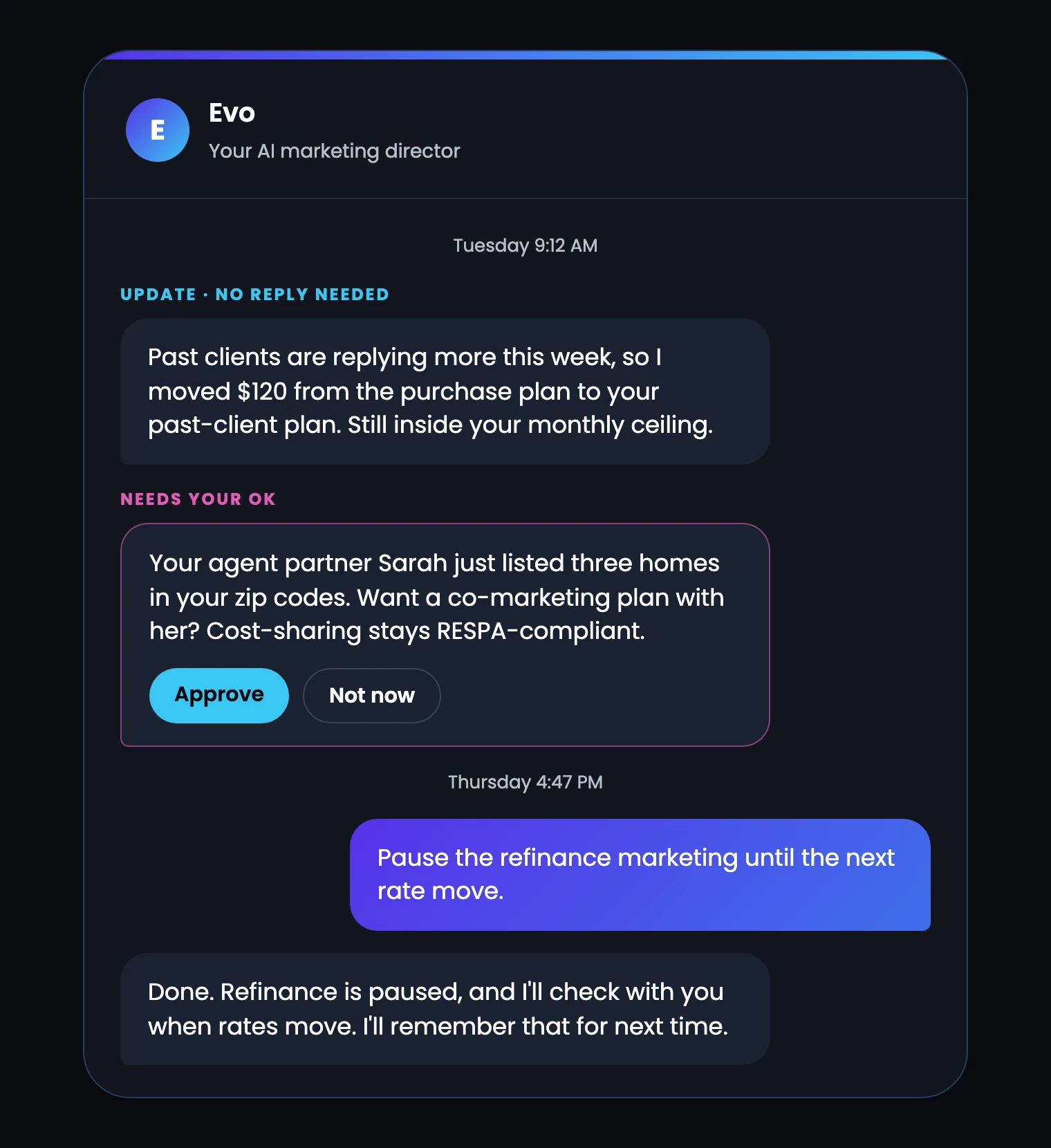
What does the director decide on its own? Inside the goal and budget you set, Evo decides the day-to-day: which audience sees which creative, when a plan needs a fresh version, how budget shifts between plans that are producing and those with headroom, and how each inquiry gets answered. These are the decisions a human marketing director would make without a meeting.
What does it ask you about? Anything that changes the goal, exceeds the ceiling, touches your brand in a new way, or needs a judgment only you can make. A new co-marketing partner. A seasonal budget increase. Marketing that is not producing the way the plan expected, with a recommendation attached. Evo brings these to you where you already are, by text or email, so you can approve or adjust.
How do you override it? You tell it. “Pause the refinance marketing until the next rate move.” “Use the newer headshot.” The instruction becomes part of Evo’s memory of how you like to work, so you say it once and each plan after that starts from your preferences.
The lender sets the outer boundary. Brand standards, disclosures, and co-marketing rules are enforced before anything launches, so compliance is a property of the plan, not a review step at the end. For many loan officers, that is what makes delegating feel safe for the first time.
Follow-up is where directing pays off fastest. The minutes after an inquiry decide who wins the borrower, and the LO cannot be available for all of them. LeadsConcierge AI calls, texts, and qualifies each new inquiry within minutes, with the context of which plan it came from, and hands you the warm conversation. We made the case for that speed in cutting mortgage lead response time to five minutes. Leads Intelligence then shows which marketing produces the inquiries that fund, so the next plan starts there.
What Do the Hours You Get Back Produce?
Loan officer marketing that runs as a directed system compounds. Audiences build, local recognition builds, and follow-up gets faster and better informed with each plan. The loan officer’s hours compound too, because they move to the three places where the LO is irreplaceable.
Borrower conversations. A pre-approval call, a rate-and-terms walkthrough, a nervous first-time buyer who needs twenty minutes. These are the hours that fund loans.
Referral partners. Most loan officers build their business with agents, and they are right to. The question that matters is what you are doing to bring value to those partners.
A director makes that easy to answer. A co-marketed listing launch carries both brands, lands on one page, and feeds one follow-up system, so the agent sees results too.
The cost is shared fairly. Co-marketing comes with cost-sharing built to stay RESPA-compliant: Each partner pays its fair share of the marketing it appears in, which is the line Section 8 of RESPA draws.
Each co-marketed plan is also a reason to be in front of that partner again next month. The relationship is the payoff, not the flyer. We wrote about the mechanics in how real estate agent and lender partnerships actually work.
Closings. The transaction, the problem-solving in week three, the follow-through that turns one funded loan into the next referral.
Loan officers and lenders running coordinated Evocalize plans show what the system produces. In each case the marketing ran continuously, and the LO’s time went to the applications, not to the marketing that produced them.

5x+ ROI
~70 loan applications in the Chicagoland market on $5,100 of brand + sphere spend.
 Dan Rogers
Rate

$1.5M
Two pre-approvals totaling ~$1.5M in volume in his first three months back with Evocalize.
 Oscar Campa
Guild Mortgage
300% ROI
$1B+ in loan applications generated at local scale across their loan officers.
Expect momentum over 6 to 12 months, not 6 to 12 days. Inquiries can arrive in the first weeks, but the compounding that makes a pipeline predictable takes time, which is why the 6-to-12-month nurture window is a loan officer’s advantage. A director keeps the marketing running through the busy months when self-run marketing would have gone quiet.
How to start directing your loan officer marketing
Getting started takes a sentence:
- Name the goal. “Keep my past clients warm.” “Be visible in my partners’ listing zip codes.” “Fill the seminar.”
- Set the ceiling. Pick a monthly budget you would keep running for a year. A few hundred dollars a month is a legitimate, effective place to start.
- Connect what you already use. Your CRM, lead sources, and creative tools plug in, so the first plan launches with your contacts and brand in place.
- Approve the first plan, then direct. Read the summaries, answer the questions, override when you want to, and spend the hours you got back on borrowers.
For the category and how to choose, start with what an AI marketing director is. The shift is already visible on the borrower side: One in five prospective buyers and current homeowners used AI tools for homebuying research in the past year, and 57% of buyers who did used it to estimate affordability, mortgage payments, or closing costs, according to the 2026 Bank of America Homebuyer Insights Report. The borrowers you want are being reached by professionals whose marketing runs continuously, whether or not the week got busy.
Frequently Asked Questions
What is loan officer marketing?
Loan officer marketing is everything a mortgage loan officer does to stay in front of the people who send and take out loans: past clients, the local sphere, referral partners like real estate agents, and new borrowers. It usually spans local visibility on search and social, co-marketing with agents, outreach to past clients, and fast follow-up on each new inquiry. With an AI marketing director, the loan officer sets the goal and the budget, and the director does the planning, building, launching, and follow-up.
What is the best way for a loan officer to market themselves?
The best loan officer marketing is always on, local, and connected: a consistent presence in the markets where your referral partners list, plans that keep past clients and your sphere warm, co-marketing that brings value to agent partners, and follow-up that answers each inquiry within minutes. The limiting factor for most LOs is not the strategy but the hours to execute it. An AI marketing director runs the execution so the loan officer can direct it and spend their time with borrowers and partners.
What marketing should a loan officer delegate?
Delegate the tasks and keep the relationships. Building creative and landing pages, setting up audiences, checking dashboards, shifting budget between plans, first-minute follow-up, and running recurring co-marketing can all be handed to an AI marketing director. Keep the goal, the budget ceiling, your brand, the approvals, and every conversation with borrowers and referral partners.
Can an AI run my mortgage marketing without me losing control?
Yes, if the system is built so you direct it. You set the goal, the budget ceiling, the brand, and the approvals, and the lender’s compliance boundaries are enforced before anything launches. With Evocalize, Evo makes the day-to-day decisions inside those boundaries, tells you what it changed, asks you about anything outside them, and reverses any decision you override. Control moves up a level; it does not go away.
How much should a loan officer spend on marketing per month?
Start with a number you would keep running for a full year, because the compounding happens over 6 to 12 months. Many loan officers run effective plans at a few hundred dollars a month, keeping their sphere warm and staying visible in their partners’ markets. More investment adds reach and more plans running at once. What matters most is that the marketing runs continuously and that the follow-up is connected to it.
Will an AI marketing director replace my relationships with real estate agents?
No. It strengthens them. Referral partners are the center of most loan officers’ businesses, and the right question is what you are doing to bring those partners value. An AI marketing director runs the co-marketed plans that put both of you in front of the same buyers, carries both brands, and feeds one follow-up system so the agent sees results too. The conversations and the relationship stay with you, and you have more time for them.
Is co-marketing with real estate agents RESPA-compliant?
It can be, when each partner pays its fair share of the marketing it appears in. RESPA Section 8 prohibits paying for referrals, so co-marketing cost has to track each party’s actual share of the plan. Evocalize runs co-marketed plans with cost-sharing built to stay RESPA-compliant, inside the compliance boundaries your lender sets.
Put Your Marketing Hours Where Only You Can Spend Them
The marketing still has to run, and it has to run every week, not just the slow ones. Hand the doing to Evo, keep the goal, the ceiling, the brand, and the override, and put the hours you get back into the borrowers and partners who fund your pipeline. Book a demo and see what a directed week looks like for your market.