



Summary
In today’s digital age, are you maximizing every channel to drive local business growth? In this episode of the Local Marketing Lab, Sai Alluri, co-founder and CEO of Momos, shares insights on multi-channel local marketing gained from his extensive experience in the restaurant tech space. Drawing from his work with over 5,000 restaurants across 10 countries, Sai reveals how businesses can create a powerful digital presence that converts online engagement into real-world revenue.
Master the digital-to-local pipeline. Before investing in marketing campaigns, businesses must build a strong foundation through customer experience and online reputation. Sai explains how to leverage review management, customer feedback, and social proof to create a solid base for multi-channel local marketing success. This approach ensures marketing dollars are spent efficiently and effectively.
Optimize local marketing ROI. National marketing campaigns often favor major metros, leaving local businesses struggling for visibility. Learn how targeted local marketing delivers better returns through community-specific content and precise measurement of in-store conversions. Sai shares real examples from working with major brands like Baskin Robbins on driving measurable local results.
Dominate digital discovery channels. Today’s customers use multiple platforms in their decision-making journey. Google and Yelp validate through reviews, while TikTok and Instagram drive discovery through visual content. Understand how to maintain a strong presence across each channel and create content that resonates with your specific local audience. This episode provides actionable strategies for businesses ready to enhance their multi-channel local marketing approach and drive sustainable growth.
Key Takeaways
Here are some topics discussed in the episode around multi-channel local marketing:
- Optimize your Google Business Profile for maximum visibility
- Leveraging social media platforms effectively for local business discovery
- The modern customer journey from digital discovery to in-store visits
- Measuring marketing ROI at the local level
- Using customer feedback and surveys to drive business improvements
Really hone in on and listening to what your customers are saying across all these channels as much as possible. Make it easier to collect more data points.
SAI ALLURI
Resources
- Connect with Sai Alluri on LinkedIn.
- Learn more about Momos.
Other shout-outs
Transcript
Justin Ulrich
What’s up everyone, and welcome to the Local Marketing Lab, where you get real-world insights from industry pros to help you drive local revenue and local for growth. This podcast is brought to you by Evocalize – digital marketing tools powered by local data that automatically work where and when your locations need it most. Learn more at evocalize.com.
What’s up? And welcome to the Local Marketing Lab. Joining us in the lab today is a guest with over a decade in the restaurant tech space. He’s a huge Patriots fan. He ran the Chicago marathon and has traveled over 35 countries in the world, including the United States. Co-founder and CEO of Momos, Sai Alluri. Welcome to the lab, my friend.
Sai Alluri
Thanks, Justin. Thanks for having me. Excited to be here.
Justin Ulrich
I’m excited to have you. You know, we’ve done our fair share of hanging out at the shows and you guys have an awesome product. So I figured it might be good to bring you on and talk to the product a little bit and how it helps folks from a local marketing standpoint.
But I guess before we jump into that, why don’t we get started with a little bit around your background and, you know where you got to where you are as the co-founder of Momos.
Sai Alluri
Perfect. Yeah. Thanks, Justin. So a little bit about me. I grew up in the East Coast, in Connecticut, hence why I’m a big die-hard Patriots fan. Did my engineering and started working in tech pretty early on in my career out at Uber. So I started working in San Francisco on their ride sharing business and then moved with Uber to Asia, where I helped build out their Uber Eats business and expand food delivery back in 2017 all over Asia Pacific.
And then I joined this other super app startup company in Southeast Asia called Grab, where I’ll build out their food delivery business and then also cloud kitchen. So I’ve spent almost close to eight or nine years in the food industry, starting with food delivery, cloud kitchens, and working with virtual brands.
And then during COVID I was actually quarantined, stuck in Singapore. And that’s when we had the idea for Momos, where we saw a lot of our favorite restaurants and customers struggling to go online, both just in terms of, like, turning on delivery, but then also using marketing, local marketing, whatever it takes to drive traffic to their online businesses.
So when we looked around in Singapore and we were trying to find softwares to support them, there wasn’t something that did all of it in one place. And my co-founder and my founding team are all actually all American. We happen to be living in Singapore when we had the idea. So we left Grab, started the company back in 2021, and then I moved back to the US a few years ago to help with expansion here.
But now we’re global. We’re in ten countries, we work with over 5000 restaurants. But, and to kind of the merit of this podcast and what we’re talking here, Justin, like marketing and everything with relationship to like digital presence, finding yourself online from Google, Yelp, Facebook, social media platforms. It’s how all the discovery is happening now and it’s where a lot of the conversion happened. So excited to kind of talk through all of that today.
Justin Ulrich
Yeah, no, that — I’m excited to have the conversation as well. I guess in addition to like online reputation management, what are the kind of the
pillars of what Momos does? You focus on that as well as what other things?
Sai Alluri
So we built an all-in-one platform here at Momos. We do everything from reputation review management, we do customer experience through surveys, we do customer service. So everything from support tickets, guest tickets that come in and then finally we do marketing in the form of CDP, SMS, email marketing, all in one place.
And the reason we built all of these into a single solution instead of trying to have them be separate is they all talk to each other and they all integrate well with each other. Right. So if you’re trying to do marketing, and we tend to focus a lot on retention marketing, which is for your existing guests and your existing customers that you’re trying to keep bringing back.
And when you’re trying to reengage your customers, it really matters to understand what they’re feeling and what their experience is like at the restaurant. Right. Like have a good experience or your loyal customers continuing to rate you well, are they looking to keep coming back? And if they are, then you can start running campaigns and marketing campaigns to keep engaging them and keep personalizing everything that you do.
So instead of keeping it separate, as separate solutions, we’ve combined all of it and everything works well together where as a restaurant operator you can understand how all your customer experience is performing. And then we also, with your POS and loyalty systems, if you’re trying to reengage them and bring them back, you could do that all in the same system as well.
Justin Ulrich
Very cool. Yeah, we talk quite often on this show about you know, ensuring that the experience within the four walls is up to snuff. You know, if you have a crummy experience or the food isn’t great or, you know, maybe your staff isn’t interacting well with your customers or your guests. Like all those things kind of ladder up to kind of a crummy experience.
And then from there, folks who typically have the worst experience, they going to be the ones that go leave reviews typically. And now you got a bunch of negative reviews and you gotta combat those things and it kind of creates this downward spiral. But if you’re able to get, you know, everything up to spec within your four walls, then you’re driving people to a good experience.
You’re amplifying that good experience through their reviews and online engagements. And then you’re able to throw marketing dollars against things and through ads and other means to drive people to your restaurant (or your location if you’re not a restaurant).
So you’re able to then get more from your marketing dollars. Make sure you don’t have a leaky bucket. You’re not just wasting money and you’re driving folks to a good experience, which is going to create this flywheel and keep people just coming back more and more often.
Sai Alluri
Exactly. No, I couldn’t have said that better, Justin. And it’s like you want to make sure that…
Justin Ulrich
No, no, you probably could have.
Sai Alluri
I think in terms of ad, before you spend marketing dollars or investing in campaigns, it could be just creative campaigns or marketing dollars. You want to make sure the current experience is as optimal as possible, like you said. Right? So you want to make sure your guests are happy they’re able to have an enjoyable experience, everything from the food to the quality of experience.
And then after that, then you can get creative and start running — either investing dollars or also starting to run new creative ideas like item drops or anything else that you’re trying to do. So that’s where we start with. It’s like, how do you make sure that you have all the information you need to look at opportunities to improve?
And then once you do that, Google, for example, like talking about local marketing is extremely important to, from a search perspective, right when people are going in and trying to find pizza near you or ice cream near you, you’re going to Google Maps, turn on the filter that says, show me the top-rated restaurants. And Google basically ranks it based on the number of reviews and the rating that you have.
So one, it’s important to make sure that more and more your customers are giving you those ratings. So you show up there and then it’s also to reduce the incident. So as your people are trying to discover you, you’re actually showing up higher and higher.
And that’s one type of marketing that we think about. It’s like, how do you ensure that you show up as high on Google as possible? By maintaining the best level of reputation with your ratings and reviews that come through.
Justin Ulrich
Yeah, it makes total sense if you think of the customer journey and if we were to put it in marketing terms you want to guide folks through this journey of awareness, to consideration, to decision. And Google Search is a really good job, especially with the map functionality of doing this. And if you look at all the different pieces of information they give you about restaurant, a gym, you know, it could be a massage place, whatever it might be, they’re gonna give you, like, where it’s located.
Okay, it’s near me. Great. Now, you know, what do others think about it? Oh, it has good reputation. Lots like high star marks. How many folks have been there? What are people actually saying? You could drill into it. How much does it cost? Right. And as you kind of go down, they order these things from top to bottom to help guide people down this funnel to making the decision, because all of these things are what we would call in the marketing world, like consideration, set pieces of information, and then ultimately they make a decision.
And that decision could come in the form of like an offer or something like that. Or it could just be very well to click the button to get directions to come into your place of business. But focusing there seems to be, well, I guess if you’re focusing within your four walls, you’re helping to boost the information that’s put out in that journey, right in that stage.
So when people are most high intent and they’re actually looking for a place near them to do XYZ, you’re going to be the one that shows up based on all that information that you’re able to pull from your guests.
Sai Alluri
Exactly right. It’s like if you look at the main channels that you think about consumers finding you a restaurant or a location business, one is obviously Google, Yelp, and then it’s social media. Everything TikTok and Instagram like food, for example, one of the best ways to discover it are through Instagram posts or reels or TikTok videos.
And food itself is so much more emotive in terms of what you can experience. And videos just stand out a lot. And I’ve gone through doom scrolls on Reels with just food videos from influencers just showcasing it, and it pops a lot. Right. So I think the modern consumer, the Gen Z consumers, are starting to use both TikTok and Instagram Reels to identify what they want.
And they also validate with Google from a rating and review perspective to go through it, right. So before these customers become regular customers, it’s important to make sure that discovery platforms, you’re online, you’re available, and then you’re highly reputable on those platforms, and then everything else can go into more retention or reengagement marketing afterwards.
Justin Ulrich
Yeah, for sure. I had a funny conversation with Maya from science on call at one of the recent events, and I think it was actually at the last event where we hung out, but we were talking, I was telling her about Facebook. I’m like, I’m not really on Facebook in my personal life. I do a lot of the social stuff for work because that’s just. I’m a marketer, right? Those are the channels that make sense to market across.
But in my personal time, I’m like, it just sucks me right in. And I just get like, I’m addicted to Facebook and scrolling. She’s like, I’m just gonna stop you right there. You’re not unique. Like, these platforms are designed to be that way, right? They’re designed to get you to doom scroll like you’re talking about.
But if you’re, you know, a business, you could take advantage of that very well if you’re able to generate, you know, organic content that resonates really well with your audience. So part of it is capturing the data, like we talk about with the tool, like yours, to learn more about your audience. And then if you create the content, to be able to serve up to those folks on the channels that they’re going to be on.
So certain demographics may use Facebook. Others, maybe a younger demographic, may be more inclined to use TikTok. But if you’re pushing the right content across the right channels, you’ll be able to connect more effectively with various segments of your guests and bring them into your establishment. Drive raving fans, all that stuff.
Sai Alluri
Yeah, definitely. And I think one of the ways that I’ve seen some of our customers and other customers do it out there is in the form of LTOs and item drops. So one of the restaurants we went to, Justin, when we were in Dallas for the conference, was Hopdoddy, and they do burgers of the month. Every month they have a different burger. And sometimes customers are like, hey, we want this to be on the regular menu because it’s so good and it’s so tasty.
But those are great ways to get your customers to keep coming back, keep trying something. And if you can build really good content around it, especially on TikTok and Instagram, as you’re scrolling through it, you’re like, oh, it’s not just the regular burger, but there’s this new item that’s just in February that I’d want to try out.
So then that actually serves as a way to drive it back to your restaurants. Again, and I’ve also seen it where some franchisees in some locations do their own specific items as well so that they can kind of launch something locally for their cities and their customer base, if that’s something is trending there, too.
Justin Ulrich
Mm hmm. Yeah. That Hobdoddy’s, first off, incredible food. I had nothing heard of them because I’m up in Charlotte, and they’re typically for those who are listening down in Texas, right? They’ve got like 40 plus locations.
Sai Alluri
Yeah, yeah, yeah.
Justin Ulrich
Oh, my goodness. They had these sweet potato fries that were like, what did they had? They were, like, hot. They were hot honey.
Sai Alluri
And I like Parmesan. Garlic was the other one.
Justin Ulrich
Oh. And they come in these huge bowls, and I’m like, dude, I could eat all of these fries. It was, it was bad, man. And the smash burger was incredible. I was actually, I came home, I told my wife all about it. I’m like, we need to go if we’re ever, like, in those areas.
Sai Alluri
We need one all over.
Justin Ulrich
We need it, man. But they do a really good job. You called out there. How they do the item drops. Like, they constantly try different, you know, things in the menu, different LTOs to try to drive some excitement, some engagement to keep people, like, coming back. And they have it as part of their brand.
They have this kind of, like, monthly, you know, menu item that, you know, if you’re a fan of Hopdoddy’s, you’re going to go there for this month. You’re going to be able to get this one thing, and if you really love it, you’re going to go a few more times that month than you typically might. So it’s a great way to increase your frequency and keep those guests coming back more and more often than they typically would.
Sai Alluri
Yeah, definitely. And then Hob actually uses some of our survey products. So for anytime they launch these new items or they’re trying to go through it, they actually look through the data and they see which ones are getting really good ratings, which ones could be improved, which ones, like, orders are actually picking up much faster.
So all that essentially ends up becoming a science for you to realize, hey, if there’s something that’s trending much better than the other items, maybe this makes sense to bring it back more often or add it to the regular menu and you can keep going from there as well.
Justin Ulrich
That’s a super cool, super cool case study. And those guys. What about some other, are there any other clients that you have? You want to highlight some cool things that they might be doing really, really well from a local marketing standpoint?
Sai Alluri
Yeah, I think one of the other experiments that we did year, a year and a half ago was with Baskin Robbins, where we actually did a few local marketing for them, where we helped them drive traffic, specifically using Facebook to their locations itself. Right.
Like, so when you look at Facebook ads and you’re trying to grow your dine in or in store sales, it’s hard to know if the person that’s viewed the ad or clicked on that actually ended up showing up at the restaurant and actually came and came through. So we have this capability where we can add offers directly to the ads. So when you run these ads, you can actually see if that customer who saw that ad actually came in and purchased it.
So that gives you a full ROI analysis of your marketing spend and then where you want to do it. So they were able to actually use it not only for this broad campaign, but in the future. If they’re seeing that there’s not as much revenue or sales coming from some of their locations, they could just run these Facebook ads specifically in those locations to drive those campaigns as well.
So we’re starting to see more experiments and testing out at a local level because we’re in the location, local business. Right. So instead of running national or like full state level campaigns, you ideally want to run everything from email, SMS, Facebook marketing campaigns at a local level to either help grow revenue or solve a problem that’s happening there.
And I think the tools and then creating the content for that specifically is something that more and more restaurateurs and more and more businesses want to experiment with. And I think what we’re trying to do is just simplify that so you’re not spending all your time trying to just craft the ad or the campaign and make it structurally work, but you can be as creative as you want, and then we can just provide the tools to make it simple to do that.
Justin Ulrich
Yeah, it’s very cool product. Yeah. If you think at the local level, it’s like you have the contents going to resonate differently in certain areas than others, and it opens the door for you to actually do things like highlight, like local heroes, hometown heroes, you know, high school quarterbacks or different, you know, team captains or whatever it might be to leverage them as local influencers.
And create different content to try to engage with the community at a deeper level than you otherwise would be able to if you’re just doing everything from like a corporate level.
Sai Alluri
Definitely.
Justin Ulrich
You mentioned, too, with regard to ads and ad spend, you know, oftentimes when you’re spending like, running national ads. You just. The platforms are designed to take your money, right? So if you have like a Google, Facebook, TikTok, Instagram, whatever, it might be like, they want to spend money as quickly as possible, basically so that they can get the percentage that they’re due from each dollar spent.
So they typically will spend those dollars in high metro areas, like high population areas, New York, Chicago, LA, places like that. And the locations that actually need the marketing are not getting the love that they need, which is where. That’s kind of where we can kind of help, you know, do local marketing at a scale, you know, from a Evocalzie standpoint, not to name drop too much with a shameless plug, but there is one right there.
But local marketing, it’s where you’re going to get the most from your dollar spent. Especially if you have a system where you’re requiring your z’s to give a certain percent of revenue to the marketing budget. If that money is getting taken and spent nationally, then typically they’re not getting the love they need from those dollars. And it’s really hard for a franchisee or a GM to swallow.
Sai Alluri
Yeah, no, it makes sense. And, like, the way I kind of think about the solutions is, like, Momos, at least the solutions we’re building for SMS and email is, again, for your existing customers that you’re trying to retain and engaging.
And I think where evil eyes comes in is with Facebook and Instagram is how do you build and acquire new customers and how do you put them into the funnel to become your regular customers and grow locally as well. So, definitely, like, different strategies and different skill sets needed to do each of those specifically.
Justin Ulrich
Yeah, very cool. Have you guys ever tried something that just didn’t work well? Like, maybe you had a failure that you failed forward and learned from?
Sai Alluri
I mean, we have those all the time. I think for us, like, the motto at Momos is we try to — we like to try a lot of pieces. Yeah, I think for us, one area that we tried building out very early on was trying to, like, bring in full Facebook, Instagram, Google Ads into Momos on top of everything else that we’re doing. And as you guys know from Evocalize, that is a monster. It is massive to be able to do that.
And what we realized was we wanted to go deeper into kind of the customer data lens of it. Start with email, start with SMS, and then partner with platforms like yourself to provide that, as opposed to kind of doing it all on your own. But it took us like a year to realize that. Right, so, so it’s. But yeah, so that was one of the learnings that where maybe it didn’t work out initially and didn’t fit with what we wanted to do.
But there’s been a lot of other areas where it has worked out even after that bet. So for us, like just culturally being a product company, we try to make these bets, especially if it’s coming directly from the restaurant and sometimes it doesn’t work and. But as when it does, then we like really scale it and help from there.
Justin Ulrich
That makes total sense. If you could give advice to those who are listening, who are trying to drive growth at a local level, what would be one thing that you’d encourage them to do today or maybe this week to help them get things moving in the right direction?
Sai Alluri
Yeah, I mean, I think for us at Momo’s, our expertise right now is with local SEO and kind of making your reputation and making sure that you’re solving for that experience first and foremost. So I would say really hone in on and listening to what your customers are saying across all these channels as much as possible.
Make it easier to collect more data points. So it’s not just limited to the one-off Google review or Yelp review that you’re getting. Try to figure out a way to get more and more your customers to leave feedback. And as they’re leaving that feedback, understand at the local level, what are areas that you can work through and fix and improve on and see if those ratings go up.
So just at a very simple level, that in itself can start driving much more organic visibility on these platforms. And then once that’s there, I think kind of going into Facebook and running other ads and marketing campaigns can happen once you have kind of the operational excellence that the customers are looking to see.
Justin Ulrich
Yeah, perfect. Now, great answer. Great answer. All right, we’re going to switch gears a little bit. So when we met, we were, last we met up was at FSTech, like we just talked about a little bit ago. And we did an event, you and I did an event together with a couple of other folks over. It was sponsored by Toast and Lunchbox. They had a pickleball event.
Sai Alluri
Yep, yep, yep.
Justin Ulrich
And you got on the bus and you said to me, what?
Sai Alluri
I think I said something about, let’s play some pickleball. I don’t know if I said something different. Did I say something different?
Justin Ulrich
You said to me, do you pickle? And I was like, is that. Apparently I don’t, because those who are listening. I played pickleball for the first time at this event, and I didn’t even realize that pickle, like, to pickle would be a verb. Right. Unless I was, like, canning, like, fruits or vegetables or something. So what I didn’t realize is that Sai would go on to actually win the entire championship. Right. Because you are that good.
Sai Alluri
I don’t think I’m that good. I think I’ve just got lucky that day. Great partner. And, yeah, I mean, it was fun, but, like, it’s. I did not think you’d bring up the pickle comment on this podcast, but. Great.
Justin Ulrich
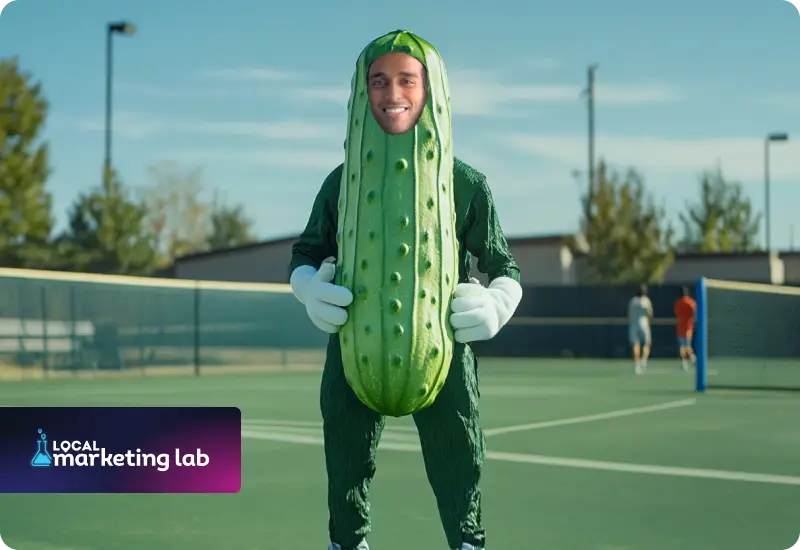
Well, not only am I going to bring up the pickle comment, I wanted to show you what AI would see you as the pickleball king. Full pickle. Yeah. Size gone. Full pickle here. All right, so now we know. Now we know that that is, for those of you who are not avid pickleballers or in the pickleball community, to pickle is a thing that one can do.
Sai Alluri
Exactly. Exactly. Especially we’re using AI memes on this podcast. I would have come ready for something else next time on the next one, then.
Justin Ulrich
The whole point of this is for you not to know so I can blindside you with you in a giant pickle costume.
Well, hey, before we jump off, because it’s time to wrap up, how should folks follow or get a hold of Momos or follow you on social?
Sai Alluri
Yeah, so we’re on LinkedIn, so I’m starting to post more regularly on LinkedIn and then Momo’s — our account also posts directly on LinkedIn, so I think that’s the best spot. And then our website’s up to date with everything else, too.
Justin Ulrich
Very cool. If you’re listening and you’re thinking about different solutions to help you manage various operational functions within your, I highly suggest check out Momo’s. They’ve got some really cool stuff. We only scratch the surface in this conversation, but the nice thing about it is kind of a one-stop shop for a lot of the different things that you need when you’re running one location or many locations. So check them out.
Subscribe to Sai. He does have some pretty good content on LinkedIn. They’ve got some fun news that’s constantly happening over at Momo. Some great customers of theirs, so check them out. Sai thanks a ton for joining us in the lab.
Sai Alluri
Awesome. Thanks so much for having me today, Justin. Appreciate it.
Justin Ulrich
You bet. Let’s go pickle.
As always, thanks for joining us in the Local Marketing Lab. This podcast was sponsored by Evocalize. To learn more about how Evocalize can help you grow your business, visit evocalize.com.
If you learned something from today’s episode, don’t forget to subscribe on your favorite podcast platform and follow us on LinkedIn and Facebook @Evocalize. That’s Evocalize and on X at Evocalize.
And remember, keep innovating and testing new things. You’ll never know what connects with your customers best unless you try. Until next time. Thanks for listening.
Show More Show Less